
Old Tax Regime vs New Tax Regime (FY 2025–2026): Compare tax slabs, deductions, exemptions, and savings to find which tax regime is better for your income.
Introduction
Every year, taxpayers in India must decide which tax regime to choose: the old one or the new one. In 2025, the government made important changes to tax slabs under the new tax regime. These changes affect how much tax you will pay in FY 2025–2026. To make a smart choice, you should compare the old tax regime vs new tax regime 2025–2026 based on the latest data. In this article, we will explain both tax regimes, how they work now, their pros and cons, and which one might be better for you.
Also Read: “How to Calculate Income Tax Payable Under the New Tax Regime (FY 2025–26) for a step-by-step calculation”
What Has Changed in 2025? (According to New Data)
- The new tax regime slab rates have been relaxed starting April 1, 2025. ClearTax+2
- The rebate under Section 87A has increased, which means individuals with taxable income up to a certain threshold will not pay any tax. The Economic Times+1
- The old tax regime slabs remain unchanged according to the new data. ClearTax+1
Old Tax Regime (with 2025 Data)
What Is the Old Tax Regime?
The old tax regime is the traditional tax system. Under this regime, you can use many deductions and exemptions to lower your taxable income.
Tax Slabs Under the Old Regime in FY 2025–2026
- Income up to ₹2,50,000 → 0% tax
- ₹2,50,001 to ₹5,00,000 → 5% tax
- ₹5,00,001 to ₹10,00,000 → 20% tax
- Above ₹10,00,000 → 30% tax
Advantages of Old Regime
- More Deductions: You can claim things like:
- Section 80C (investments up to ₹1.5 lakh)
- Health insurance (80D)
- Home loan interest
- HRA (House Rent Allowance)
- Good for Savers: If you regularly invest in tax-saving schemes, this regime helps you reduce taxable income.
- Flexible Planning: You can plan your investments and deductions to lower tax.
Disadvantages of Old Regime
- You need to keep proof of investments and expenses.
- More paperwork.
- If you don’t make many investments, the benefit may be low.
New Tax Regime (with 2025 Data)
What Is the New Tax Regime?
The new regime is meant to be simpler. It has more tax slabs and lower rates but allows very few deductions.
Updated Tax Slabs for FY 2025–2026
According to the latest budget data: ClearTax+2
- Up to ₹4,00,000 → 0% tax
- ₹4,00,001 to ₹8,00,000 → 5% tax
- ₹8,00,001 to ₹12,00,000 → 10% tax
- ₹12,00,001 to ₹16,00,000 → 15% tax
- ₹16,00,001 to ₹20,00,000 → 20% tax
- ₹20,00,001 to ₹24,00,000 → 25% tax
- Above ₹24,00,000 → 30% tax
Key Benefits of the New Regime (2025)
- No Tax for Income Up to ₹12 Lakh (Effectively): Because of the larger rebate under Section 87A, the net tax for many people up to ₹12 lakh becomes zero. Kbas
- Simplicity: With fewer deductions, tax calculation and filing becomes easier.
- Standard Deduction: A standard deduction of ₹75,000 is available for salaried individuals. ClearTax
Also Read: “New Income Tax Slab and Rates – FY 2025-26 (AY 2026-27)”
Disadvantages
- Very few deductions are allowed (only a few like standard deduction, and employer NPS contribution). The Economic Times
- Not very beneficial if you have big investments or loans.
- For high-income people, tax may increase in some cases if deductions used to be large.
Old Tax Regime vs New Tax Regime 2025–2026: Key Comparison
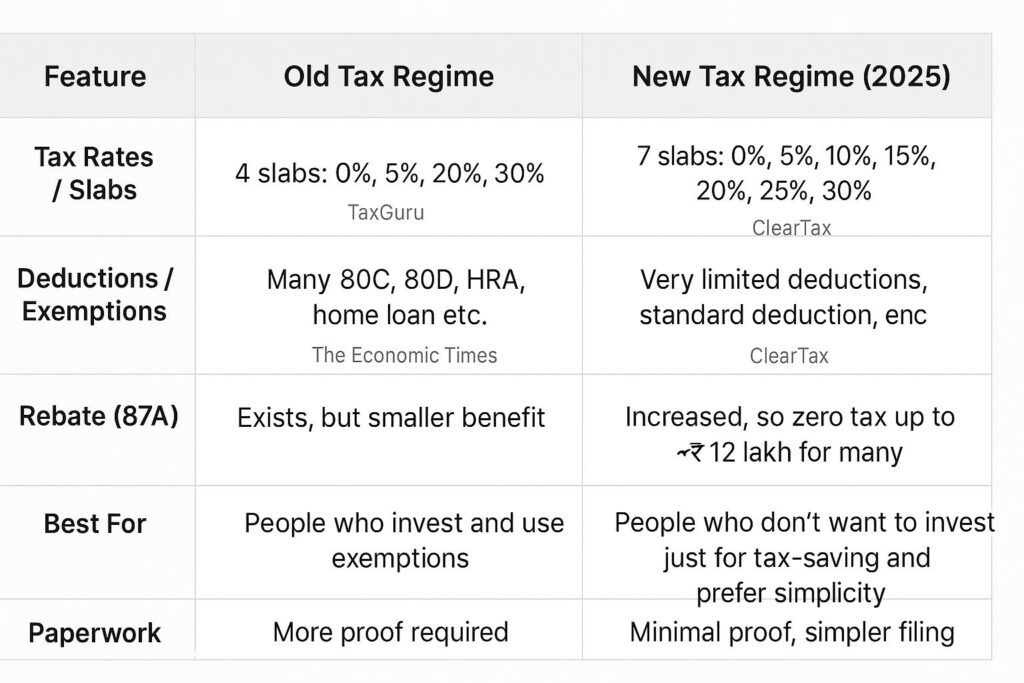
Also Read: “Old Tax vs New Tax Regime Fy-2025-2026: by The Times of India”
Which Regime Is Better (2025)?
Deciding which tax regime is better in FY 2025–2026 depends on your income level and how much you invest / claim deductions.
Choose Old Regime if:
- You make a lot of investments (PPF, ELSS, NPS) or pay for insurance.
- You have home loan interest or HRA.
- You are okay doing paperwork and keeping proofs.
Choose New Regime if:
- You don’t invest much in tax-saving schemes.
- You want a simple tax system.
- Your taxable income is up to about ₹12 lakh (because of higher rebate).
Example Comparison (Income: ₹12,00,000)
Old Regime Calculation
Income = ₹12,00,000
Deductions = ₹2,00,000
Taxable income = ₹10,00,000
Tax
- 5% slab = ₹12,500
- 20% slab = ₹1,00,000
Total tax = ₹1,12,500 + 4% cess
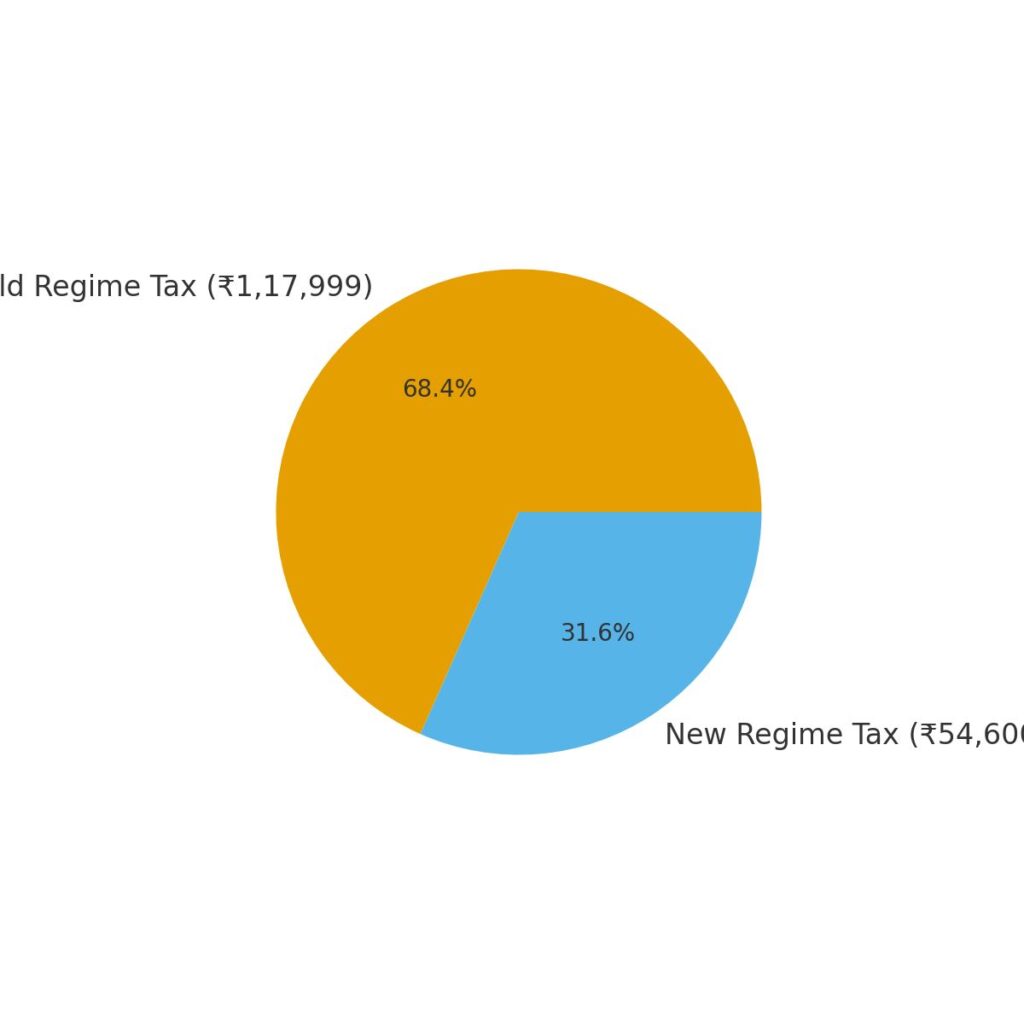
Final tax = ₹1,17,999
New Regime Calculation
Income = ₹12,00,000
Standard deduction = ₹75,000
Taxable income = ₹11,25,000
Tax
- 5% slab = ₹20,000
- 10% slab = ₹32,500
Total tax = ₹52,500 + 4% cess
Final tax = ₹54,600
New Regime Saves About ₹63,399
Risks & Things to Remember (2025)
- 4% cess applies to both
- Surcharge applicable above ₹50 lakh
- You can switch regimes yearly (not for business income)
- The ₹12 lakh tax-free benefit is due to rebate, not slab
- Future budgets may change numbers
Conclusion
With the new data for FY 2025–2026, the new tax regime is better for many taxpayers because it is simple and offers zero tax up to about ₹12 lakh. But the old tax regime is still better for people who invest a lot and claim many deductions.
To decide between the old tax regime vs new tax regime 2025–2026, check:
- Your income
- Your investment habits
- Your deductions
- Your preference for simplicity or savings
A simple rule:
Low deductions → New
FAQs
1. What are the new tax slabs for FY 2025–2026?
Slabs start at 0% up to ₹4 lakh and go up to 30% above ₹24 lakh.
2. What is the new rebate limit?
Many people with taxable income up to ₹12 lakh pay zero tax.
3. Has the old regime changed?
No, it remains the same as before.
4. Are deductions allowed in the new regime?
Only a few:
- Standard deduction
- Employer NPS contribution
5. Which regime is better for ₹10 lakh income?
- With deductions → old regime
- Without deductions → new regime