
Alternative Investment Funds (AIFs) in India explained: types, benefits, risks, returns, and how beginners can invest in AIFs safely in 2026.
Introduction
Many people in India want better returns than normal savings, FDs, or mutual funds. As the Indian market grows, a new option is becoming very popular — Alternative Investment Funds. These funds allow smart investors to earn higher returns by investing in special asset classes like startups, real estate, private companies, debt funds, and many more.
In this simple and easy article, you will learn what Alternative Investment Funds are, how they work, their types, benefits, risks, minimum investment amount, and how beginners can start investing in AIFs in India.

Also Read: “10 Best Ways to Invest Money in 2025 – Smart Beginner Guide.”
What Are Alternative Investment Funds?
Alternative Investment Funds (AIFs) are special types of investment funds that invest money in assets other than normal stocks and mutual funds.
These include:
- Private companies
- Startups
- Real estate
- Hedge funds
- Debt funds
- Special situation funds
- Infrastructure projects
“AIFs ke baare me adhik jaankari ke liye official SEBI page bhi dekhein Alternative Investment Funds (AIFs) – SEBI Official Page.”
Why are AIFs becoming popular in India?
Because many investors want:
- Higher returns
- Better risk control
- Professional fund management
- Access to high-growth companies
Alternative Investment Funds offer all these benefits.
How Do Alternative Investment Funds Work?
AIFs collect money from investors and invest it in carefully chosen assets. A professional fund manager handles your money and tries to generate high returns.

Also read: NPS vs PPF: Which Is Better Investment for Retirement in India?
Here is how the process works:
- AIF creates a fund scheme
- Investors put money into the scheme
- Fund manager invests the money in assets
- Fund earns profits or losses
- Profits are shared with investors
AIFs usually have a lock-in period, meaning you cannot withdraw money anytime you want.
Types of Alternative Investment Funds in India
In India, Alternative Investment Funds are regulated by SEBI. SEBI has classified Alternative Investment Funds into three main categories based on risk, investment style, and purpose.
1. Category-I Alternative Investment Funds
Category I Alternative Investment Funds invest in sectors that support economic growth and social development. These funds are generally encouraged by the government.
Types:
- Venture Capital Funds: Invest in startups and early-stage companies with high growth potential.
- Angel Funds: Invest in new business ideas at an early stage. Minimum investment is ₹25 lakh.
- Social Venture Funds: Focus on education, healthcare, and social impact projects.
- Infrastructure Funds: Invest in roads, power, and infrastructure projects for long-term returns.
Who should invest?
Long-term investors who are comfortable with higher risk and want to support economic growth.
2. Category-II Alternative Investment Funds
Category II Alternative Investment Funds are the most popular AIF category in India. These funds do not use leverage except for daily operations.
Types:
- Private Equity Funds: Invest in established companies to improve growth and profitability.
- Debt Funds: Invest in unlisted debt instruments and offer relatively stable income.
- Fund of Funds: Invest in other Alternative Investment Funds for diversification.
Who should invest?
Investors looking for a balance between risk and return with a long-term view.
3. Category-III Alternative Investment Funds
Category III Alternative Investment Funds use advanced trading strategies and may use leverage and derivatives.
Types:
- Hedge Funds: Invest in listed and unlisted securities with high-risk strategies.
- PIPE Funds: Invest in listed companies through private placements.
Who should invest?
Experienced investors with high risk appetite and strong market understanding.
“AIFs ke performance aur comparison dekhne ke liye PMS Bazaar ka detailed page bhi dekhein — Alternative Investment Funds (AIFs) – PMS Bazaar.”
Benefits of Alternative Investment Funds
Also read: SIP vs Lumpsum: Which Is Better Investment in 2026? Returns, Risk & Tax.
AIFs offer many strong advantages that normal mutual funds cannot provide.
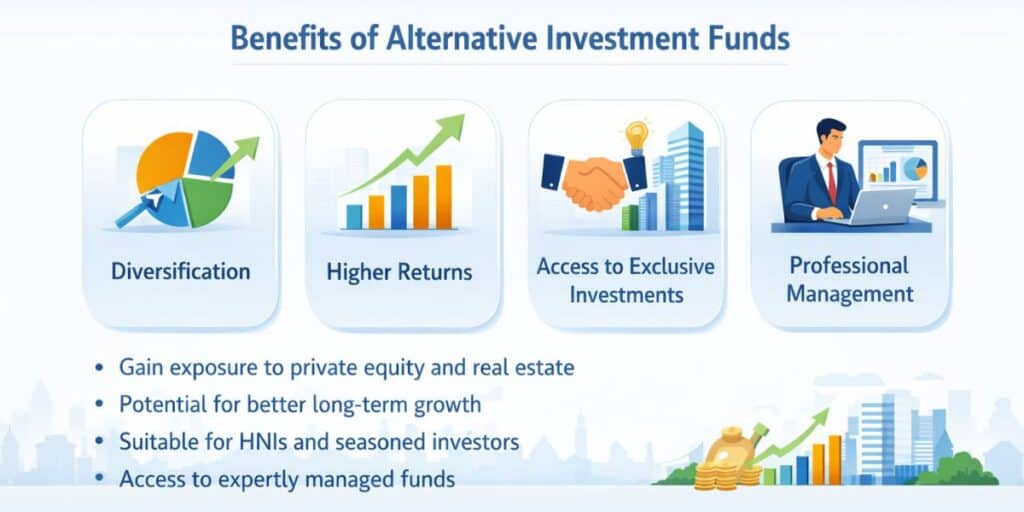
1. Diversification
Investments are spread across many sectors and assets, reducing risk.
2. Higher Returns
AIFs invest in high-growth assets like startups and private companies, which may give higher returns.
3. Access to Exclusive Investments
Normal investors cannot invest in private companies or special deals.
AIFs provide this access legally and safely.
4. Professional Management
Experts research, select, and manage investments.
5. Tax Benefits (in Some AIFs)
Category I and II AIFs often offer tax-efficient structures.
Long-term investors ke liye value investing ek proven strategy hai. Agar aap detail me samajhna chahte hain, to yeh guide zaroor padhein:
“Value Fund: Best Value Mutual Funds in India for High Returns (2026 Guide”
Who Should Invest in Alternative Investment Funds?
AIFs are suitable for investors who:
- Have high income
- Want to diversify beyond mutual funds
- Are ready for long-term investment
- Want higher returns
- Are comfortable with medium–high risk
If you are a new or small investor, mutual funds are better.
How to Invest in Alternative Investment Funds in India
Investing in AIFs is simple if you meet the requirements.
Also read: RD vs FD: Which Is Better in 2026? Returns, Interest Rates & Best Choice.
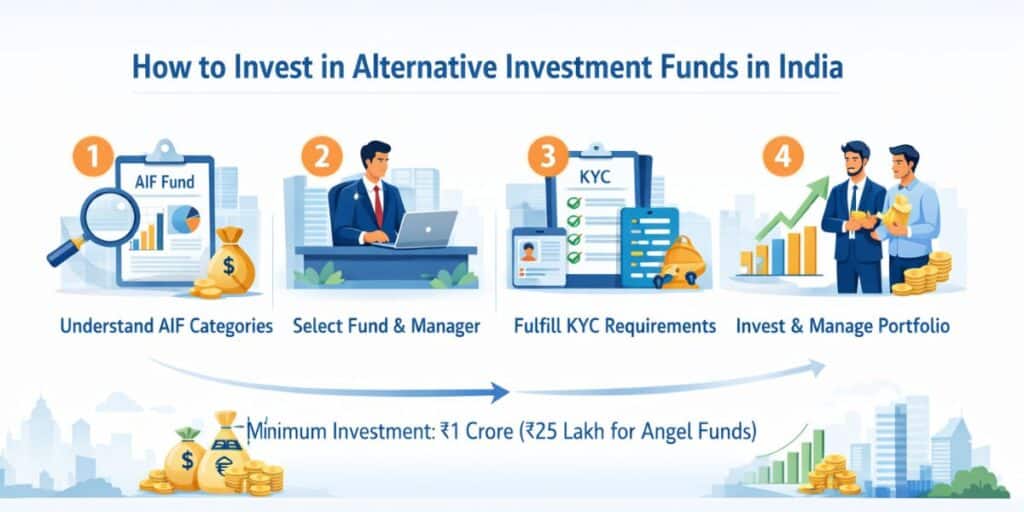
Step 1: Check Eligibility
You must:
- Be 18+
- Have a net worth suitable for AIF investment
- Invest at least ₹1 crore
Step 2: Select the AIF Category
Choose:
- Category I
- Category II
- Category III
Step 3: Complete KYC
Provide:
- PAN card
- Aadhaar card
- Bank details
Step 4: Sign the Agreement
You will receive:
- Private Placement Memorandum (PPM)
- Fund agreement
Step 5: Transfer Funds & Start Investment
After funds are received, investment begins.
Minimum Investment Amount for AIFs
As per SEBI rules:
- Minimum Investment: ₹1,00,00,000 (1 Crore)
- For employees of AIF: ₹25 lakh
- For angel investors: ₹25 lakh
So AIFs are mainly for High-Net-Worth Individuals (HNIs).
Best Sectors for AIF Investment in 2026
| Sector | Why Invest | Risk | Best For |
|---|---|---|---|
| Startups & Venture Capital | High growth startups, AI, FinTech, HealthTech | High | High risk investors |
| Private Equity | Established companies, long-term growth | Medium | Long-term investors |
| Real Estate | Commercial properties, rental income | Medium | Income + growth seekers |
| Infrastructure | Roads, energy, logistics projects | Medium | Long-term stable returns |
| Distressed Assets | Assets at discounted price, NCLT resolutions | High | Experienced investors |
| Healthcare & Pharma | Medical innovation, exports, aging population | Medium | Long-term investors |
| Technology & AI | Automation, digital solutions, enterprise tech | High | Growth-focused investors |
Note: Alternative Investment Funds (AIFs) are high-risk, long-term investments. Always check with a financial advisor before investing.
Conclusion
Alternative Investment Funds are becoming a powerful investment option for India’s wealthy investors. They provide higher returns, professional management, and access to exclusive opportunities like startups and private companies. However, AIFs come with high risk and a high minimum investment of ₹1 crore.
If you are looking for long-term growth and can handle medium-to-high risk, AIFs can be a great choice. But if you are just starting your investment journey, you should first build a base through mutual funds and savings plans.
“Aap safe returns ke options dekh rahe hain? Ye guide padhein: Best Debt Investment 2025 in India – Safe & Low-Risk Options.”
Frequently Asked Questions (FAQ)
Q1: What is the meaning of Alternative Investment Funds in simple words?
AIFs are special investment funds that invest in startups, private companies, real estate, and other high-growth assets.
Q2: Are AIFs safe?
They offer high returns but also come with higher risk.
Q3: Who regulates Alternative Investment Funds in India?
SEBI regulates all AIFs.
Q4: Can beginners invest in AIFs?
Yes, but only if they have ₹1 crore or more and understand the risks.
Q5: What is the lock-in period?
Depends on the fund but usually ranges from 3–7 years.