
Confused between RD and FD? Learn which saving option is better for you, how much interest you can earn, and make your money grow safely.
Introduction
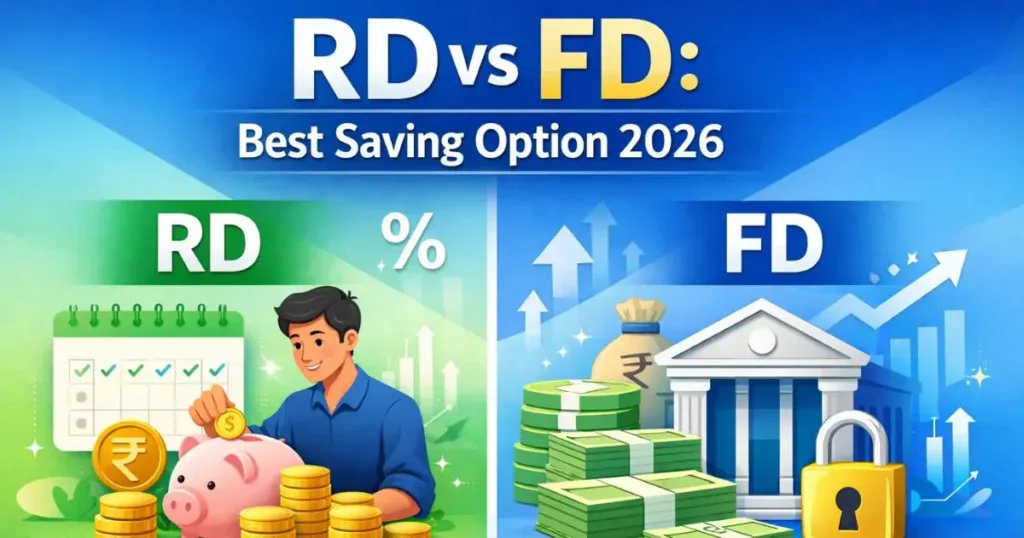
Saving money is very important for a safe future. Many people in India choose simple and safe options like RD and FD. But many beginners feel confused — RD vs FD: which is the best saving option for you in 2026?
Both RD (Recurring Deposit) and FD (Fixed Deposit) are popular because they are safe and easy to understand. They are offered by banks and post offices. In this article, you will learn the difference between RD and FD, their benefits, returns, and which one is better for your needs.
“FD vs RD: Key Differences, Features & Which is Better – By Bajaj Finserv”
What is RD (Recurring Deposit)?
An RD (Recurring Deposit) is a saving plan where you invest a fixed amount every month for a set time.
Key Features of RD
- You deposit money every month
- Fixed interest rate
- Safe investment option
- Good for small savings
Example
If you invest ₹5,000 every month in RD for 2 years, you will get a fixed return with interest at the end.
What is FD (Fixed Deposit)?
An FD (Fixed Deposit) is a plan where you invest a lump sum amount for a fixed time.
Key Features of FD
- One-time investment
- Fixed interest rate
- Safe and stable returns
- Flexible time period
Example
If you invest ₹1,00,000 in FD for 2 years, you will earn fixed interest on that amount.
RD vs FD: Key Differences
| Feature | RD | FD |
|---|---|---|
| Investment Type | Monthly | One-time |
| Best For | Regular savers | Lump sum investors |
| Flexibility | Medium | High |
| Returns | Fixed | Fixed |
| Risk | Very Low | Very Low |
Agar aap safe aur long-term investment plan kar rahe hain, to FD vs PPF – Best Investment Option in 2026 ka comparison zaroor dekhein.
RD vs FD: Which Gives Better Returns?
In RD vs FD, both give almost similar interest rates. But the total return depends on how you invest.
- In RD, money is invested monthly, so interest is earned gradually
- In FD, full money earns interest from day one
FD usually gives slightly higher returns if you already have a large amount
RD vs FD: Which is Better for You?

“FD vs RD: Which is Better for Safe Money Growth in 2025? – CASHe”
Choose RD if:
- You want to save money monthly
- You do not have a large amount
- You want to build a saving habit
Choose FD if:
- You have a lump sum amount
- You want stable returns
- You want flexible tenure
RD vs FD Interest Rates
Interest rates are an important part of the RD vs FD comparison.
- RD interest rates usually range from 6% to 7.5% per year
- FD interest rates usually range from 6% to 8% per year
Senior citizens often get 0.25% to 0.50% extra interest on FD and RD.
FD may offer slightly higher returns than RD for the same tenure.
RD vs FD Risk Comparison
Both RD and FD are considered low-risk investments.
Safety
- Backed by banks and NBFCs
- Covered under DICGC insurance up to ₹5 lakh per bank
Market Risk
- RD: No market risk
- FD: No market risk
In terms of safety, RD vs FD are equally secure.
RD vs FD: Liquidity (Withdrawal)
RD
- Early withdrawal allowed with penalty
- Less flexible
FD
- Easy to withdraw before maturity
- Penalty may apply
FD is more flexible than RD.
RD vs FD: Real-Life Example
RD Example
You invest ₹5,000 per month for 2 years
Total investment = ₹1,20,000
Returns = Fixed with interest
FD Example
You invest ₹1,20,000 one time
Returns = Higher than RD (slightly)
FD wins if you have full money at the start.
RD vs FD Taxation
Tax rules are very important when comparing RD vs FD.
RD Tax Rules
- Interest earned is taxable
- Added to your income and taxed as per your slab
- No TDS on RD interest
FD Tax Rules
- Interest is taxable
- TDS applicable if interest exceeds ₹40,000 (₹50,000 for senior citizens)
In RD vs FD, tax treatment is almost the same.
Long-term wealth creation ke liye Fixed Deposit vs SIP – Which Is Better Investment in 2026? samajhna bahut zaroori hai.
RD vs FD: Advantages and Disadvantages
RD Advantages
- Easy monthly saving
- Good for beginners
- Disciplined saving habit
RD Disadvantages
- Lower returns than FD
- Less flexible
FD Advantages
- Higher returns (in most cases)
- Flexible tenure
- One-time investment
FD Disadvantages
- Requires large amount
- Taxable interest
Conclusion:
The choice between RD vs FD depends on your income pattern, savings amount, and financial goals. Both are safe investment options and suitable for conservative investors.
- Choose RD if you want to save money every month, have a regular income, and want to build a disciplined saving habit.
- Choose FD if you have a lump sum amount, want slightly higher guaranteed returns, and better liquidity.
RD is ideal for beginners and small savers, while FD is better for surplus money, bonuses, or retirement funds.
Also read: “How to Withdraw PF Through ATM and UPI Easily in 2025.”
Frequently Asked Questions (FAQs)
Q1. RD vs FD: Which is better for beginners?
RD is better for beginners because it allows small monthly investments and builds a saving habit.
Q2. Is RD safer than FD?
No, both RD and FD are equally safe as they are bank-backed investments.
Q3. Can I break RD or FD before maturity?
Yes, both RD and FD can be withdrawn before maturity, but a penalty may apply.
Q4. Which gives better returns, RD or FD?
FD usually gives slightly higher returns than RD for the same tenure.
Q5. Is RD or FD good for long-term investment?
RD and FD are best for short- to medium-term goals. For long-term wealth creation, equity mutual funds are better.