
A home equity loan allows homeowners to borrow against the value they’ve built in their property. In this 2026 guide, learn what a home equity loan is, how it works, monthly payments, current interest rates, home equity loan examples, and the key differences between a home equity loan, HELOC, mortgage, and home loan.

For many homeowners in the United States, a home is more than just a place to live—it is also a valuable financial asset. As property values increase and mortgage balances decrease over time, homeowners build equity in their homes. A home equity loan allows you to borrow against that equity and access cash for major expenses such as home renovations, debt consolidation, education costs, or emergency expenses.
But what exactly is a home equity loan, how does it work, and how does it compare to a HELOC or mortgage? In this comprehensive 2026 guide, you’ll learn everything you need to know about home equity loans, including payments, interest rates, eligibility requirements, benefits, risks, and alternatives.
What Is a Home Equity Loan?
A home equity loan is a type of secured loan that allows homeowners to borrow money using the equity in their home as collateral.
Home equity is the difference between your home’s current market value and the amount you still owe on your mortgage.
Example:
- Home Value: $400,000
- Remaining Mortgage Balance: $250,000
- Home Equity: $150,000
In many cases, lenders allow you to borrow up to 80%–85% of your home’s equity, depending on your credit profile and lender requirements.
Because the loan is secured by your home, interest rates are typically lower than personal loans or credit cards.
Ready to explore home equity loan options? Compare rates and offers from trusted lenders to find the best loan for your needs.
Check Home Equity Loan Offers
What Is a Home Equity Loan in Simple Terms?
In simple terms, a home equity loan allows homeowners to borrow money against the value they have built in their property. The lender provides a lump-sum amount based on the available home equity, and the borrower repays the loan through fixed monthly payments. Since the loan is secured by the home, interest rates are generally lower than those of personal loans and credit cards.
This answers the common question: what is a home equity loan and how does it work? Simply put, homeowners use their property’s equity as collateral to access cash for various financial needs.
Home Equity Loan Example
A home equity loan example can help illustrate how the process works.
Suppose:
- Home Value: $500,000
- Remaining Mortgage Balance: $300,000
- Available Equity: $200,000
If a lender allows borrowing up to 80% of the home’s value, the homeowner may qualify to borrow a portion of that equity based on creditworthiness and income requirements.
This home equity loan example shows how homeowners can use their property’s value to finance home improvements, debt consolidation, education expenses, or other major costs.
How Does a Home Equity Loan Work?
A home equity loan provides a lump sum payment upfront. Once approved, you receive the entire loan amount and repay it through fixed monthly installments over a predetermined period.
Step-by-Step Process
1. Determine Available Equity
The lender evaluates your home’s current market value and mortgage balance.
2. Submit an Application
You’ll provide:
- Income documentation
- Employment information
- Credit history
- Property details
3. Home Appraisal
Many lenders require an appraisal to determine your home’s current value.
4. Loan Approval
The lender reviews your:
- Credit score
- Debt-to-income ratio
- Home equity
- Income stability
5. Receive Funds
After approval and closing, the money is disbursed as a one-time lump sum.
6. Repayment Begins
You make fixed monthly payments that include principal and interest.
For additional information about home equity loans, eligibility requirements, and borrower rights, homeowners can review the guidance provided by the Consumer Financial Protection Bureau (CFPB) Home Equity Guide
What Is a Home Equity Loan Payment?
A home equity loan payment is the fixed monthly amount you pay to repay the loan.
Unlike variable-rate products, payments generally remain consistent throughout the loan term.
Monthly payments depend on:
- Loan amount
- Interest rate
- Loan term
- Fees (if applicable)
Example
Suppose you borrow:
- Loan Amount: $50,000
- Interest Rate: 8%
- Loan Term: 15 Years
Your monthly payment would remain fixed for the life of the loan, making budgeting easier.
This predictability is one reason many homeowners choose a home equity loan over other financing options.
Home Equity Loan Interest Rates in 2026
Many homeowners ask, what is a home equity loan interest rate and what is a home equity loan rate today. Home equity loan rates vary by lender, credit score, loan amount, loan-to-value ratio (LTV), and overall market conditions. Borrowers with excellent credit and substantial home equity typically qualify for the most competitive rates.
Interest rates vary based on:
- Credit score
- Loan amount
- Loan-to-value ratio (LTV)
- Income
- Property location
- Economic conditions
Factors That Influence Rates
Excellent Credit (740+)
Borrowers with strong credit histories typically qualify for the lowest available rates.
Good Debt-to-Income Ratio
Lower debt obligations often result in better loan terms.
Strong Home Equity Position
More equity generally means lower risk for lenders.
Loan Term
Shorter loan terms may offer lower interest rates than longer repayment periods.
Fixed Interest Rates
One major advantage of home equity loans is that they usually come with fixed interest rates. This means:
- Stable monthly payments
- Easier financial planning
- Protection from future rate increases
Compare today’s home equity loan rates from multiple lenders and see what you may qualify for.
Compare Rates Now
What Is a Home Equity Line of Credit (HELOC)?
A Home Equity Line of Credit (HELOC) is another way to borrow against your home’s equity.
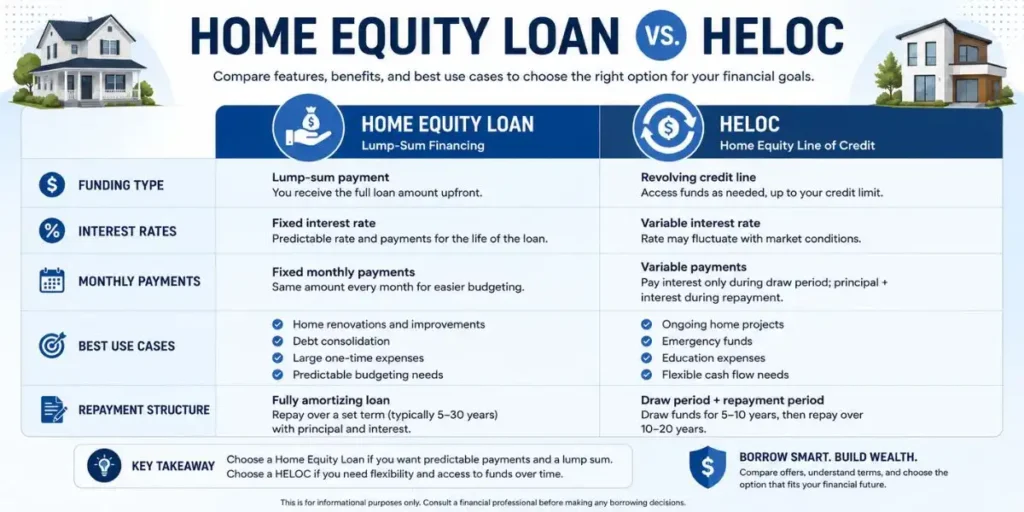
If you’re wondering what a home equity line of credit is, a HELOC is a revolving credit account secured by your home’s equity that allows you to borrow funds as needed rather than receiving a single lump-sum payment.
Unlike a home equity loan, a HELOC functions similarly to a credit card. Instead of receiving a lump sum upfront, you receive a revolving line of credit that you can draw from as needed during the draw period.
Key Features of a HELOC
- Revolving credit line
- Flexible borrowing
- Variable interest rates in most cases
- Draw period and repayment period
This flexibility makes HELOCs attractive for ongoing expenses such as home remodeling projects, education costs, and emergency expenses.
Home Equity Loan vs HELOC
Many homeowners compare home equity loans and HELOCs before deciding which borrowing option best fits their financial needs. While both allow you to access your home’s equity, they differ in how funds are received, repayment structures, and interest rates.
| Feature | Home Equity Loan | HELOC |
|---|---|---|
| Funds Received | Lump Sum | Revolving Credit Line |
| Interest Rate | Usually Fixed | Usually Variable |
| Monthly Payments | Fixed | Can Change |
| Best For | One-Time Expenses | Ongoing Expenses |
| Predictability | High | Moderate |
Choose a Home Equity Loan If:
- You need a specific amount of money.
- You prefer fixed payments.
- You want predictable repayment.
Choose a HELOC If:
- You need flexible access to funds.
- Expenses will occur over time.
- You’re comfortable with variable rates.
Not sure whether a Home Equity Loan or HELOC is right for you? Compare lenders and loan options online.
Find the Best Option
Home Equity Loan vs Mortgage
Many homeowners ask, what is a home equity loan vs mortgage. Although both loans use your home as collateral, they serve different purposes.
Mortgage
A mortgage is a loan used to purchase a home. The lender provides funds to buy the property, and the borrower repays the loan through monthly installments over a set period.
Home Equity Loan
A home equity loan allows homeowners to borrow against the equity they have already built in their property. The funds can be used for various purposes, such as home improvements, debt consolidation, education expenses, or major purchases.
| Feature | Mortgage | Home Equity Loan |
| Purpose | Buy a Home | Borrow Against Equity |
| Loan Position | First Lien | Usually Second Lien |
| Funding | Home Purchase | Cash Access |
| Repayment | Monthly | Monthly |
A home equity loan is often called a “second mortgage” because it exists alongside your primary mortgage.
Home Equity Loan vs Home Loan
Many borrowers search for Home Equity Loan vs Home Loan when comparing financing options.
| Feature | Home Loan (Mortgage) | Home Equity Loan |
|---|---|---|
| Purpose | Purchase a home | Borrow against existing home equity |
| Property Ownership | Buying a new property | Already own the property |
| Loan Type | Primary mortgage | Usually a second mortgage |
| Funds Usage | Home purchase | Any eligible personal purpose |
A home loan helps you buy a house, whereas a home equity loan allows you to access cash using the equity already built in your property.
Benefits of a Home Equity Loan
1. Lower Interest Rates
Rates are often lower than credit cards and unsecured personal loans.
2. Fixed Payments
Predictable monthly payments simplify budgeting.
3. Large Borrowing Amounts
Homeowners may access significant funds based on available equity.
4. Multiple Uses
Funds can be used for:
- Home improvements
- Debt consolidation
- Medical expenses
- Education costs
- Major purchases
5. Potential Tax Benefits
Depending on current tax laws and how funds are used, interest may be tax-deductible. Consult a qualified tax professional for guidance.
For additional information, see the IRS Mortgage Interest Deduction Guidelines.
Risks of a Home Equity Loan
While there are advantages, there are also risks.
1. Your Home is Collateral
Failure to repay could result in foreclosure.
2. Additional Debt
Borrowing increases your overall financial obligations.
3. Closing Costs
Some lenders charge fees for:
- Appraisals
- Origination
- Processing
- Closing
4. Reduced Home Equity
Borrowing decreases the equity available in your property.
Before applying for a home equity loan, it is important to understand the potential risks, costs, and responsibilities involved. The Federal Trade Commission (FTC) Home Equity Information provides additional guidance on home equity loans, credit lines, borrowing costs, and consumer protections.
Requirements for Home Equity Loan
Most lenders look for:
Sufficient Home Equity
Typically at least 15%–20% equity remaining after borrowing.
Good Credit Score
Many lenders prefer scores of 620 or higher.
Stable Income
Proof of reliable income is usually required.
Acceptable Debt-to-Income Ratio
Lenders evaluate your ability to repay the loan comfortably.
Property Verification
The home typically must meet lender eligibility standards.
Is a Home Equity Loan Right for You?
A home equity loan may be a good option if:
- You have substantial equity.
- You need a lump sum of money.
- You prefer predictable monthly payments.
- You have a stable income.
- You can comfortably manage repayment.
However, because your home secures the loan, borrowing should be approached carefully.
Compare multiple lenders, review fees, and understand repayment obligations before proceeding.
Looking for competitive home equity loan rates in 2026? Compare lenders and get personalized offers in minutes.
Get Started Today
Conclusion
A home equity loan can be an effective way to unlock the value you’ve built in your home. It provides a lump sum of cash, fixed interest rates, and predictable monthly payments, making it a popular financing option for homeowners in 2026.
Before applying, evaluate your financial goals, compare lenders, and understand the differences between a home equity loan, HELOC, and traditional mortgage. When used responsibly, a home equity loan can help fund important expenses while potentially offering lower borrowing costs than many other financing options.
Read more:
- 10 Money Mistakes to Avoid in Your 30s (Before It’s Too Late)
- The 5/20/30/40 Rule Explained: Smart Way to Avoid Home Loan Stress
FAQs
1. What is a home equity loan?
A home equity loan is a secured loan that allows homeowners to borrow money using the equity in their property as collateral.
2. How does a home equity loan work?
The lender provides a lump sum payment upfront, and the borrower repays the loan through fixed monthly installments over a set term.
3. What is a home equity loan vs HELOC?
A home equity loan provides a lump-sum amount with fixed payments, while a HELOC offers a revolving line of credit that allows flexible borrowing as needed.
4. What credit score is needed for a home equity loan?
Most lenders prefer a credit score of at least 620, though higher scores often qualify for better rates.
5. Can I use a home equity loan for any purpose?
In most cases, yes. Common uses include home improvements, debt consolidation, education expenses, and emergency costs.
6. What is a home equity loan vs mortgage?
A mortgage is used to purchase a home, whereas a home equity loan allows homeowners to borrow against the equity they have already built in their property.
7. What happens if I cannot repay a home equity loan?
Since your home serves as collateral, missed payments could eventually lead to foreclosure.
8. What is a home equity loan payment?
A home equity loan payment is the fixed monthly amount a borrower pays toward principal and interest throughout the loan term.
9. What is a home equity loan interest rate?
A home equity loan interest rate is the cost of borrowing against your home’s equity, expressed as an annual percentage rate.
10. What is a home equity loan line of credit?
A home equity line of credit (HELOC) is a revolving credit line secured by home equity that allows flexible borrowing.
11. What is a home equity loan rate today?
Home equity loan rates change regularly based on market conditions, lender policies, credit score, and loan-to-value ratio.