
Learn how to plan retirement in India (2026) and build a secure ₹2 crore+ corpus with smart investments, SIP, and pension strategies.
Introduction
Most people work their entire lives to earn money — but very few plan properly for their Retirement Planning. The truth is, if you don’t start planning early, you might struggle financially in your golden years.
The good news? Retirement planning in India is easier than you think — if you follow the right steps. In this article, we’ll show you how to plan for retirement step-by-step, how much you should save, where to invest, and how to build a ₹2+ crore retirement corpus.

What is Retirement Planning?
Retirement planning means preparing financially for life after you stop working. The goal is to:
- Maintain your lifestyle without worrying about money.
- Cover healthcare and essential expenses.
- Remain financially independent throughout retirement.
Step 1: Set Your Retirement Planing Goal
Before you invest a single rupee, decide what kind of life you want after retirement. Ask yourself:
- At what age do I want to retire? (e.g., 55 or 60)
- How much monthly income will I need?
- Where will I live — city, hometown, or abroad?
- Do I want to travel or pursue expensive hobbies?
Example:
If your monthly expense is ₹40,000 today, inflation may increase it to ₹1,00,000 in 30 years. That means you’ll need about ₹2.5–3 crore to live comfortably for 20 years after retirement.
Step 2: Calculate Your Retirement Corpus
A simple formula to estimate how much you’ll need:
Retirement Corpus = Monthly Expense × 12 × 20
Example: ₹1,00,000 × 12 × 20 = ₹2.4 crore.
Step 3: Start Investing Early
The earlier you start, the less you need to invest monthly.
Here’s how much SIP you’ll need to reach ₹2.5 Cr (at ~12% return):
| Age you start | Monthly SIP needed |
|---|---|
| 25 | ₹5,000 – ₹6,000 |
| 30 | ₹8,000 – ₹10,000 |
| 35 | ₹15,000 – ₹17,000 |
| 40 | ₹25,000+ |
Even small monthly SIPs can grow big with the power of compounding.
Check this guide on SIP vs Lumpsum – Best Investment Strategy in 2026 to make smarter investment decisions.
Step-4. “Best Investment Options for Retirement Planning”
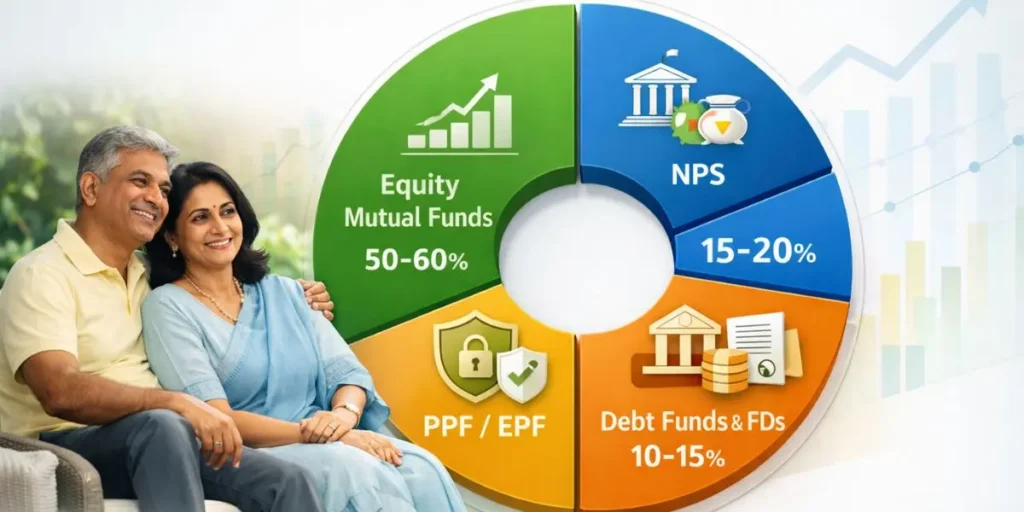
A balanced retirement portfolio gives growth, safety, and regular income:
Retirement Planning in India: A Practical Guide (FineEdge)
1. Equity Mutual Funds (50–60%)
- High long-term returns (~12%)
- Ideal through SIPs in large-cap, flexi-cap, or index funds
2. NPS (15–20%)
- Government-backed
- Tax benefits under 80C & 80CCD(1B)
- Pension after retirement
3. PPF / EPF (10–15%)
- Safe, tax-free, and guaranteed returns (~7–8%)
4. Debt Funds / Bonds / FDs (10–15%)
- Stability and regular income after retirement
Step 5: Increase Your Investment Every Year
Increase your SIP by 5–10% annually as your income grows. This small habit can help you reach your retirement corpus faster.
Step 6: Cover Your Risks
- Get term life insurance for family protection.
- Buy health insurance — medical costs are rising fast.
- Keep an emergency fund (6–12 months’ expenses).
Step 7: Review and Rebalance
- Review your plan every 1–2 years.
- Shift gradually from equity to safer investments as you near retirement.
Example Plan (Age 30 → ₹2.5 Cr at 60)
| Investment Type | Monthly Amount | Expected Return | Final Value |
|---|---|---|---|
| Equity Mutual Funds | ₹6,000 | ~12% | ₹1.4 Cr |
| NPS | ₹3,000 | ~10% | ₹75 Lakh |
| PPF | ₹2,000 | ~7.5% | ₹50 Lakh |
| Total | ₹11,000 | — | ₹2.6 Cr ✅ |
Final Tips for Retirement Planning in India
- Start early — time is your biggest asset.
- Don’t rely only on EPF or pension.
- Keep your portfolio diversified.
- Stay consistent — don’t stop SIPs during market dips.
Conclusion
Retirement planning isn’t just about saving — it’s about investing smartly and consistently. Even ₹5,000/month invested early can grow into ₹1+ crore by retirement.
Start today. Your future self will thank you for taking this step towards a stress-free and financially independent retirement.
Also read: How to Build Wealth in Your 40s: 7 Proven Strategies for Financial Freedom.
Frequently Asked Questions (FAQs)
Q1. What is retirement planning and why is it important in India?
Retirement planning ka matlab hai future ke liye financial security create karna. India me yeh important hai kyunki private jobs me pension system limited hai aur inflation continuously badh raha hai.
Q2. What is the ideal age to start retirement planning?
Retirement planning ideally 20s ya early 30s me start kar dena chahiye. Early start se compounding ka benefit milta hai aur kam investment se bhi bada corpus ban sakta hai.
Q3. How much money is required for retirement in India?
Required retirement corpus aapke monthly expenses, lifestyle aur inflation par depend karta hai. Generally, ₹1 crore se ₹5 crore ka corpus long-term retirement ke liye target kiya jata hai.
Q4. Which are the best investment options for retirement in India?
India me popular retirement options hain:
- Mutual Funds (SIP)
- EPF (Employee Provident Fund)
- PPF (Public Provident Fund)
- NPS (National Pension System)
- Fixed Deposits
5. Is SIP a good option for retirement planning?
Haan, SIP (Systematic Investment Plan) retirement planning ke liye best options me se ek hai kyunki yeh disciplined investing aur long-term wealth creation me help karta hai.
Q6. What is the 4% rule in retirement planning?
4% rule ke according, aap apne retirement corpus ka 4% har saal withdraw kar sakte hain bina corpus jaldi khatam kiye. Yeh rule long-term sustainability ke liye use hota hai.
Q7. Which is the most reliable retirement plan in India?
EPF, PPF, and NPS are the most reliable options due to safety and stable returns. Combining them with SIP gives better long-term growth.
“Aap apna retirement kis age me lena chahte ho? Humein comment me jarur bataye!”