
Want to become a mutual fund distributor in India? This step-by-step guide explains the eligibility, NISM certification, AMFI registration, commission structure, and how to start your career as a mutual fund distributor in 2026.
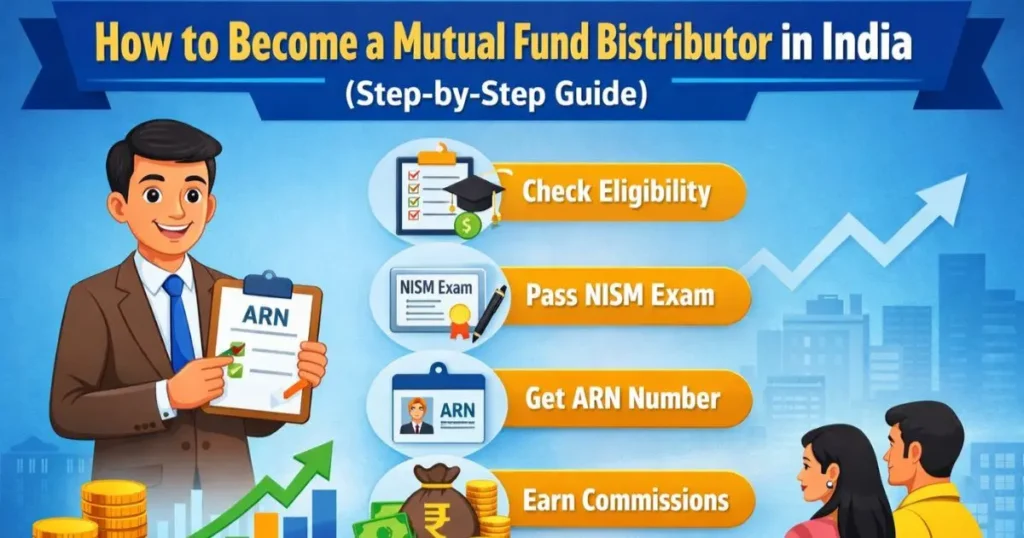
Mutual funds are becoming very popular in India. More people now want to invest their money for long-term goals like retirement, children’s education, and wealth creation. Because of this growing demand, the need for trained and trusted mutual fund distributors is also increasing.
If you are interested in finance and want to help people invest wisely, learning how to become a mutual fund distributor in India can open the door to a stable and rewarding career. This guide explains the complete process in simple English, step by step, so that even beginners can understand it easily.
What is a Mutual Fund Distributor?
A mutual fund distributor is a person who helps investors choose and invest in mutual fund schemes. The distributor works as a bridge between investors and mutual fund companies.
Before you understand how to become a mutual fund distributor in India, it is important to know the key responsibilities:
- Educating investors about mutual funds
- Helping investors select suitable schemes
- Assisting with investment and documentation
- Providing long-term support and guidance
Why Choose Mutual Fund Distribution as a Career?
1. High Growth Opportunity
India has millions of people who still do not invest in mutual funds. This gives huge growth potential to every Mutual Fund Distributor in India.
2. Low Cost to Start
You do not need big capital. The main cost is the NISM exam and AMFI registration.
3. Flexible Working Hours
You can work full-time or part-time. Many people start along with a job or business.
4. Long-Term Income
You earn trail commission every year as long as clients stay invested.
5. Respect and Trust
You help people plan their future goals like children’s education and retirement.
These benefits make many people search for how to become a Mutual Fund Distributor in India as a career option.
Eligibility Criteria:
- Minimum age: 18 years
- Education: 12th pass (10+2)
- Must clear NISM Series V-A exam
- Must register with AMFI
There is no need for a finance background. Students, housewives, salaried employees, and retired persons can all apply.
Before investing in mutual funds, it is important to understand the difference explained in Direct vs Regular Mutual Fund Plan: Which is Better in 2026
How to Become a Mutual Fund Distributor in India?

Step 1: Pass the NISM Series V-A Exam
This exam is mandatory to become a Mutual Fund Distributor in India.
Exam Details:
- Conducted by: NISM
- Mode: Online
- Questions: 100 multiple-choice questions
- Time: 2 hours
- Passing marks: 50%
- Certificate validity: 3 years
The exam checks basic knowledge of mutual funds, risk, returns, and investor protection.
NISM (National Institute of Securities Markets) – For mandatory certification courses for mutual fund distributors.
Step 2: Apply for AMFI Registration (ARN Number)
After passing the NISM exam, the next step in how to become a Mutual Fund Distributor in India is applying for an ARN (AMFI Registration Number).
Documents Required:
- NISM certificate
- PAN card
- Aadhaar card
- Passport-size photo
- Bank details
- Address proof
Once your ARN is approved, you are officially recognized as a Mutual Fund Distributor in India.
AMFI (Association of Mutual Funds in India) – Official site for mutual fund distributors, registration, and latest industry updates.
Step 3: Complete KYD (Know Your Distributor)
KYD is mandatory for all distributors. It helps AMFI verify your identity and background. This can be done online or through CAMS or KFintech centers.
Step 4: Tie Up With Mutual Fund Platforms or AMCs
To start business smoothly, you can tie up with:
- Individual AMCs
- OR a mutual fund distributor platform
These platforms help with online investments, SIP management, and commission tracking.
Role and Responsibilities of a Mutual Fund Distributor
A Mutual Fund Distributor in India has many responsibilities:
- Understanding client financial goals
- Explaining mutual fund schemes clearly
- Helping in SIP and lump-sum investments
- Providing regular portfolio updates
- Educating clients about market ups and downs
Good service helps in long-term client retention and income growth.
“When advising clients on investment strategies, it’s helpful to read our guide on SIP vs Lumpsum: Which Is Better Investment in 2026? Returns, Risk & Tax to understand the pros and cons.
How Do Mutual Fund Distributors Earn Money?
To understand how to become a Mutual Fund Distributor in India, it is important to know the income model. Distributors mainly earn through trail commission, while upfront commission is now very low or nil.
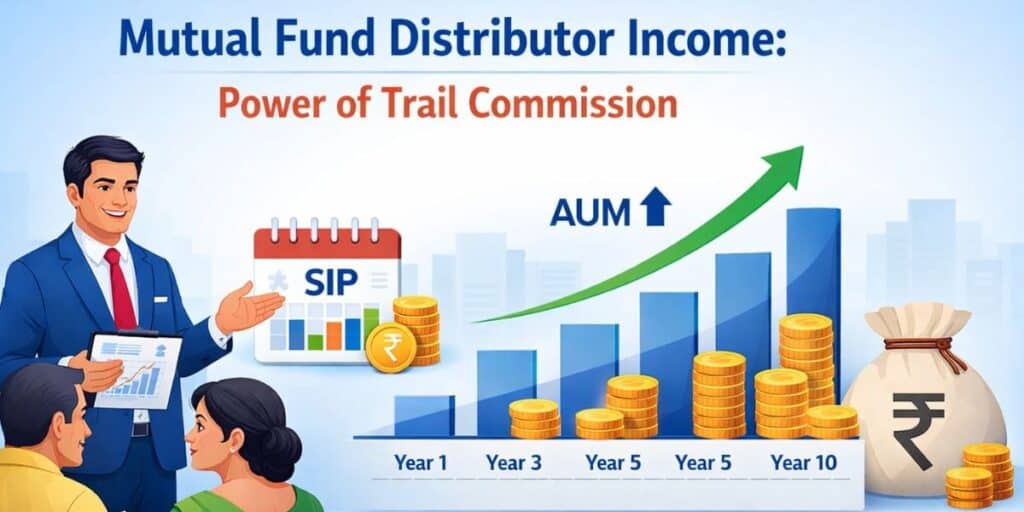
Trail Commission
It is paid every year on Assets Under Management (AUM). As long as investors stay invested, income continues, creating long-term stability.
Upfront Commission
Earlier common, but now almost nil. The focus is on ethical selling and long-term client service.
Example: Year 1 Income Example
- Number of clients: 100
- Average SIP per client: ₹5,000 per month
- Total monthly SIP collection: ₹5,00,000
- Total yearly investment: ₹60 lakh
- Average trail commission: 0.75%
Year 1 AUM (approx): ₹50 lakh
Yearly income: ₹37,500
Monthly income: ₹3,125
At this stage, income looks small. Many beginners who are learning how to become a Mutual Fund Distributor in India feel discouraged, but this is only the starting phase.
Year 3 Income Example
Assume the following:
- Old clients continue their SIPs
- 50 new clients are added
- Market growth increases AUM
Total AUM after 3 years: ₹2 crore
Trail commission at 0.75%:
- Yearly income = ₹1,50,000
- Monthly income = ₹12,500
Now income starts improving without much extra effort. This is the stage where people truly understand the power of how to become a Mutual Fund Distributor in India.
Year 5 Income Example
Assume:
- Total clients: 300
- Average SIP: ₹6,000 per month
- Strong market performance
- High client trust and retention
Total AUM after 5 years: ₹5 crore
Income calculation:
- 0.75% of ₹5 crore = ₹3,75,000 per year
- Monthly income ≈ ₹31,250
At this stage, mutual fund distribution becomes a serious and stable career for those who correctly followed the process of how to become a Mutual Fund Distributor in India.
Year 10 Income Example (Power of Compounding for Distributors)
With consistency, honesty, and investor trust:
- Total clients: 600+
- Mix of SIP and lump-sum investments
- Strong long-term AUM growth
Total AUM after 10 years: ₹15 crore
Trail commission income:
- 0.75% of ₹15 crore = ₹11,25,000 per year
- Monthly income ≈ ₹93,750
This income comes every year, even if you stop adding many new clients. This clearly shows why learning how to become a Mutual Fund Distributor in India is a smart long-term career decision.
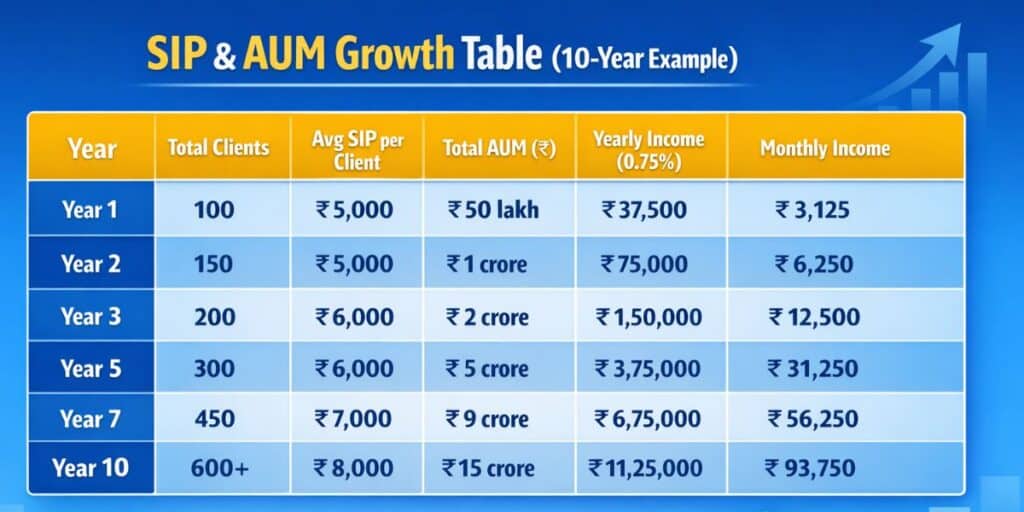
SIP & AUM Growth Table (10-Year Example)
| Year | Total Clients | Avg SIP per Client | Total AUM (₹) | Yearly Income (0.75%) | Monthly Income |
|---|---|---|---|---|---|
| Year 1 | 100 | ₹5,000 | ₹50 lakh | ₹37,500 | ₹3,125 |
| Year 2 | 150 | ₹5,000 | ₹1 crore | ₹75,000 | ₹6,250 |
| Year 3 | 200 | ₹6,000 | ₹2 crore | ₹1,50,000 | ₹12,500 |
| Year 5 | 300 | ₹6,000 | ₹5 crore | ₹3,75,000 | ₹31,250 |
| Year 7 | 450 | ₹7,000 | ₹9 crore | ₹6,75,000 | ₹56,250 |
| Year 10 | 600+ | ₹8,000 | ₹15 crore | ₹11,25,000 | ₹93,750 |
“You can estimate long-term returns using our ₹5000 SIP for 10 Years – Calculate Your Returns Using SIP Calculator 2025
Skills Required to Succeed
You do not need advanced finance knowledge, but some skills help a lot:
- Basic communication skills
- Trust building
- Patience and honesty
- Simple understanding of money and goals
- Willingness to learn continuously
These skills help you succeed after learning how to become a Mutual Fund Distributor in India.
Common Mistakes New Distributors Should Avoid
1. Promising High Returns
Mutual funds are market-linked. Never promise guaranteed returns.
2. Ignoring SIP Investors
SIP clients give long-term stable income.
3. Not Educating Clients
Educated clients stay invested for a long time.
4. Lack of Follow-Up
Regular follow-up builds trust and loyalty.
Future Scope of Mutual Fund Distributors in India
SEBI (Securities and Exchange Board of India) – Regulatory authority for mutual funds and distributors in India.
The future of this career is very bright:
- Growing financial awareness
- Increasing SIP culture
- Rising middle-class income
- Digital investment platforms
Experts believe that the number of mutual fund investors in India will double in the coming years. This makes learning how to become a Mutual Fund Distributor in India a smart long-term decision.
Conclusion
Becoming a Mutual Fund Distributor is one of the best low-risk and long-term career options in India. It requires very little investment but offers recurring income and professional respect.
If you follow the correct process, clear the NISM exam, and complete AMFI registration, you can successfully start your journey. Understanding how to become a Mutual Fund Distributor in India today can help you build a strong financial future while helping others grow their wealth.
Start small, stay honest, and grow step by step.
Related Articles
- How to Invest in Direct Mutual Funds Online in India
- Assets Under Management (AUM): Definition, Calculation
- Difference Between SIP and Mutual Fund: Which is better?
- SIP vs Lumpsum: Which is Better?
Frequently Asked Question (FAQs)
Q1. Is a Finance degree required to become a Mutual Fund Distributor in India?
No, only 12th pass education and NISM certification are required.
Q2. How long does it take to become a Mutual Fund Distributor?
It usually takes 2–4 weeks if documents are ready.
Q3. Can I do this business part-time?
Yes, many people do it along with a job or business.
Q4. Is income fixed every month?
No, income depends on AUM and client investments.
Q5. Is renewal required?
Yes, NISM certification and ARN need periodic renewal.
Q6. Is Mutual Fund Distribution Safe and Legal in India?
Yes, it is completely legal and regulated by SEBI and AMFI. All rules are designed to protect investors and ensure transparency.
As long as you follow guidelines, mutual fund distribution is a safe and respected profession.
Q7. How much do MF distributors earn?
Mutual Fund distributors in India earn through commissions from AMCs, mainly in two forms — upfront commission (one-time) and trail commission (recurring income).
- Upfront commission: Approx 0.5%–1% (limited now)
- Trail commission: Approx 0.2%–1% annually (main income source)
For example, if a distributor manages ₹50 lakh AUM, they can earn around ₹25,000–₹50,000 per year as passive income.
About Author
Written by Sujeet Kumar, founder of SujeetFinanceHub, where readers learn about personal finance, credit cards, investing, insurance, loans, and government schemes in simple and easy-to-understand language.