
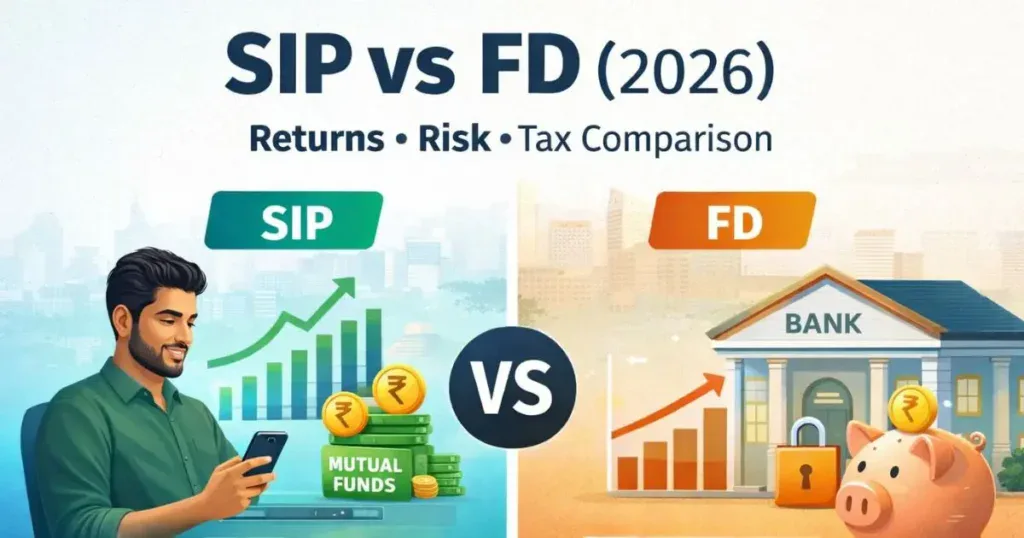
In 2026, investing ₹5,000 per month in SIP vs FD can create a difference of ₹60,000+ in just 5 years—but which option is actually better for you?
The short answer: SIP is better for long-term wealth creation, while FD is ideal for safety and guaranteed returns in the short term.
When it comes to safe and reliable investment options, Fixed Deposit (FD) and Systematic Investment Plan (SIP) are two of the most popular choices among Indian investors. Both options help you grow your savings over time, but they work very differently. Understanding the difference between SIP and FD is essential before deciding which one suits your financial goals.
In this article, we compare SIP vs FD in terms of risk, returns, flexibility, liquidity, and tax implications to help you make an informed investment decision.
What is SIP?
A Systematic Investment Plan (SIP) is a disciplined way to invest in mutual funds. Instead of investing a lump sum, you invest a small amount regularly—monthly, quarterly, or yearly. SIP allows you to benefit from market growth through rupee cost averaging and compounding.
“According to Association of Mutual Funds in India, SIP is one of the most disciplined ways to invest in mutual funds.”
Key Features of SIP:
- Investment in equity, debt, or hybrid mutual funds
- Small amount starts from ₹500
- Long-term wealth creation
- Power of compounding
- Market-linked returns
What is FD?
A Fixed Deposit is a traditional investment offered by banks and financial institutions. When you invest in an FD, you deposit a lump sum amount for a fixed period at a predetermined interest rate. Your money grows steadily over the tenure, and you get a guaranteed return on maturity.
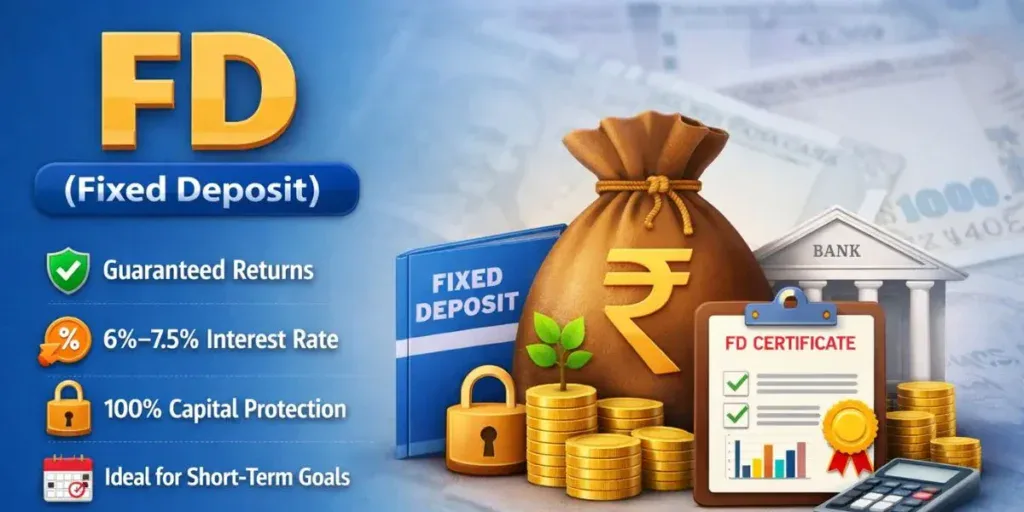
“Fixed deposits are considered safe as they are regulated by the Reserve Bank of India and offer stable returns.”
Key Features of FD
- Guaranteed returns
- Fixed interest rate
- Low risk
- Suitable for conservative investors
- Tenure from 7 days to 10 years
“If you want to compare FD with other safe options, read our detailed guide on RD vs FD – Which is Better Saving Option in 2026.”
SIP vs FD: Risk Comparison
Risk in SIP
- Market risk involved
- Short-term ups and downs
- Low risk if invested for long term
Risk in FD
Risk of lower real returns due to inflation
Very low risk
Bank-backed safety
SIP vs FD: Tax Comparison
Tax on SIP
- Equity SIP (long-term):
- 10% LTCG tax above ₹1.25 lakh
- Short-term gains taxed at 15%
- Tax-efficient for long-term investors
Tax on FD
- Interest fully taxable
- Taxed as per income slab
- No tax-saving benefit (except tax-saving FD)
SIP vs FD: Returns Comparison
| Feature | SIP | FD |
|---|---|---|
| Average Returns | 10%–14% (equity long-term) | 6%–7.5% (bank FD) |
| Risk | Market-linked, can fluctuate | Very low, guaranteed |
| Inflation Protection | Yes, usually beats inflation | No, may not beat inflation |
| Tax Efficiency | Long-term equity gains: 10% above ₹1.25 lakh; Short-term: 15% | Fully taxable as per income slab |
| Minimum Investment | Starts from ₹500 | Usually ₹1,000+ |
| Liquidity | Can redeem anytime (except ELSS lock-in) | Premature withdrawal allowed with penalty |
| Safety | Depends on market performance | Bank-backed, very safe |
| Tenure | Flexible, long-term preferred | 7 days to 10 years |
| Best For | Long-term wealth creation (5+ years) | Short-term goals & capital safety |
If your investment horizon is only 1 year, it’s important to choose the right option. Read our complete guide on Best Investment Options for 1 Year in India (2026 Guide).”
Free SIP vs FD Calculator India (2026)
“Apna amount daalein aur compare karein SIP vs FD returns instantly”
“SIP vs FD Calculator”
Use our calculator above to check your returns
Example:
- ₹10,000 SIP (10 years) → ₹8.2 lakh
- FD → ₹7 lakh
Liquidity: Which is More Flexible?
Liquidity plays an important role in short-term and emergency financial planning.
- FDs come with a lock-in period. Early withdrawal usually leads to a penalty or reduced interest rate.
- SIPs offer better liquidity. You can redeem your units anytime without penalty (except for tax-saving mutual funds, which have a 3-year lock-in).
Therefore, SIPs are more flexible compared to FDs.
SIP vs FD: Which is Better?
Choose SIP If:
- Your goal is long-term wealth creation
- You can stay invested for 5+ years
- You want to beat inflation
- You can handle market ups and downs
Choose FD If:
- You want guaranteed returns
- You need money in short term
- You are a conservative investor
- Capital safety is your priority
SIP vs FD for Different Goals
| Goal | Best Option |
|---|---|
| Short-term (1 year) | FD |
| Emergency fund | FD |
| Retirement | SIP |
| Wealth creation | SIP |
Conclusion
In 2026, your choice between SIP and FD comes down to your goals, risk appetite, and investment horizon.
- FD keeps your money safe with guaranteed returns — perfect for short-term needs.
- SIP grows your wealth over time, beats inflation, and builds long-term financial freedom.
The smartest move? Combine both: FD for emergencies, SIP for long-term growth.
Also read:
FAQs
Q1. Is SIP better than FD in 2026?
Yes, SIP is better for long-term wealth creation, while FD is better for safety.
Q2. Which is safer, SIP or FD?
FD is safer because it gives guaranteed returns.
Q3. Can SIP give negative returns?
In the short term, yes. But in the long term, SIP usually gives positive returns.
Q4. Is FD good for retirement planning?
FD alone is not enough. SIP is better for retirement planning.
Q5. Can I invest in SIP and FD together?
Yes, this is the smartest investment strategy in 2026.
Q6. How much is 5000 for 5 years in SIP SBI?
₹5,000 monthly SIP for 5 years can grow to around ₹3.8–4.2 lakh, depending on returns (10–12% approx).
Q7. How much is 3000 monthly SIP for 5 years?
₹3,000 monthly SIP for 5 years can grow to around ₹2.3–2.5 lakh, depending on returns (10–12% approx).
Very nice 💯
Pingback: Fixed Deposit vs PPF: Which is the best option for you? - sujeetfinancehub.com
Pingback: 10 Best Ways to Invest Money in 2025 | Smart Beginner Guide - sujeetfinancehub.com