
Assets Under Management (AUM) is a key term in investing that shows the total money a fund or company manages for investors. You’ll often see AUM mentioned in mutual funds, ETFs, and wealth products because it reflects the size, trust, and scale of a fund.
AUM changes regularly as markets move and investors add or withdraw money. Understanding Assets Under Management helps you judge a fund’s strength and popularity.
In this guide, you’ll learn what AUM means, how it’s calculated, and why it matters when choosing investment options.
What is Assets Under Management (AUM)?
Assets Under Management (AUM) is the total market value of money that a financial institution or investment company manages for its clients. Simply put, it shows how much money investors have trusted a fund to handle.
AUM includes different types of investments such as stocks, bonds, mutual funds, ETFs, cash, and other financial products. The value of these assets changes with market movements and investor activity.
For example, if a mutual fund manages ₹1,000 crore of investor money, then its Assets Under Management is ₹1,000 crore. The higher the AUM, the stronger the trust and scale of the fund.
Type of Assets in AUM
Assets Under Management may include different types of investments, such as:
- Equity investments – shares of companies
- Debt instruments – bonds, government securities
- Hybrid investments – mix of equity and debt
- Cash holdings – money kept for liquidity
The value of these assets changes daily based on market price.
How is Assets Under Management Calculated?
AUM Calculation Explained
There is no single fixed formula, but AUM is generally calculated as:
AUM = Total Market Value of All Managed Assets
The value of Assets Under Management changes because of:
- Increase or decrease in market prices
- New investments by investors
- Redemption or withdrawal of money
Example of AUM Calculation
If a mutual fund:
- Has ₹500 crore invested in stocks
- ₹300 crore in bonds
- ₹200 crore in cash
Then total Assets Under Management = ₹1,000 crore
If markets go up, AUM increases. If investors withdraw money, AUM decreases.
If you’re planning to invest in stocks or mutual funds, choosing the right platform is important. This Best Demat Account for Beginners in India (2026) guide helps you compare features, charges, and ease of use.
Why is Assets Under Management Important?
Assets Under Management is important because it helps investors understand the size and popularity of a fund or company.

India Mutual Fund AUM Latest Data – AMFI Official.
Key reasons why AUM matters:
- Shows investor trust in a fund
- Indicates stability and market presence
- Helps compare similar mutual funds
- Impacts fund expenses and costs
A higher AUM usually means more investors trust the fund.
India Assets Under Management (AUM) Chart-FY 2024-26
| Period | India MF AUM (₹ Lakh Crore) | Key Insight |
|---|---|---|
| Mar 2024 | 60.20 Lakh Crore | Steady growth with rising SIP inflows |
| Mar 2025 | 65.74 Lakh Crore | Broad investor participation increasing |
| Nov 2025 | 80.80 Lakh Crore | Record milestone; strong retail & SIP inflows |
| Dec 2025 | 81.00 Lakh Crore (approx.) | Equity inflows slowed, debt outflows; overall AUM remains robust |
| FY 2025-26 (proj) | 85.50 Lakh Crore | Expected moderate growth due to continued investor interest |
| FY 2028-29 (proj) | 1.99 Lakh Crore (Wealth Mgmt) | Wealth management AUM expected to double, reflecting rising affluence |
If you’re confused about choosing between stock-based and fixed-income investments, read Equity vs Debt Funds: Differences & Which is Better in 2026? for a detailed comparison of risk, returns, and suitability.
Assets Under Management in Mutual Funds
In mutual funds, Assets Under Management shows how much money the fund house is managing. Fund houses like large AMCs usually have very high AUM.
High AUM mutual funds often:
- Have better research resources
- Enjoy economies of scale
- Are considered more stable
However, very high AUM in some equity funds may also reduce flexibility.
Does High AUM Mean Better Returns?
AUM vs Performance
A common question is: Does higher AUM mean better returns?
The answer is not always.
- High AUM = popularity and trust
- Returns depend on fund strategy and market conditions
Some small or mid-sized funds with lower AUM may perform better than very large funds.
So, investors should look at:
- Past performance
- Fund manager experience
- Expense ratio
- Investment objective
AUM should be one factor, not the only factor.
“You can estimate long-term returns using our ₹5000 SIP for 10 Years – Calculate Your Returns Using SIP Calculator 2025
Advantage of High Assets Under Management
High Assets Under Management offers several advantages:
- Stability – large funds are less risky to shut down
- Lower expense ratio – costs are spread across more investors
- Better liquidity – easier buying and selling of units
- Strong brand value – more trust among investors
These benefits make high AUM funds attractive to conservative investors.
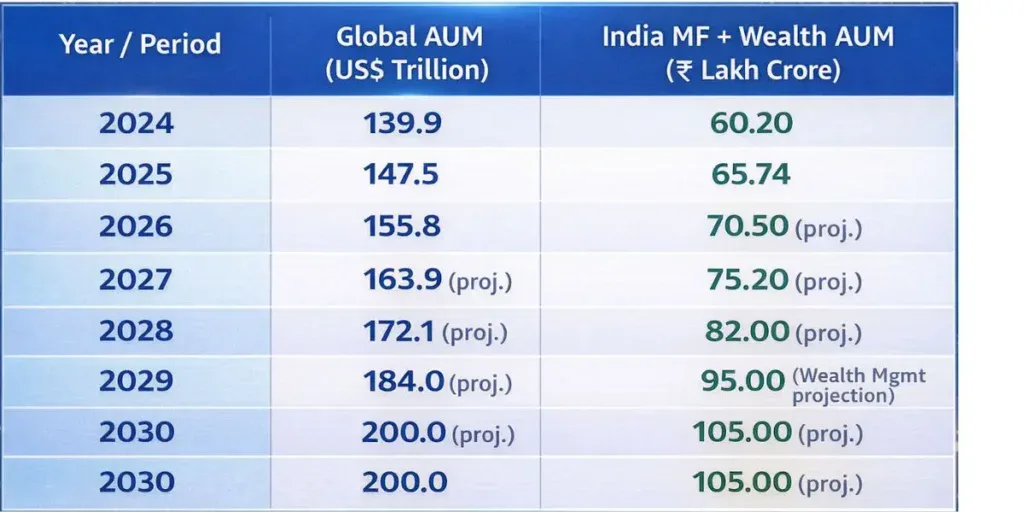
Global vs India AUM – Line Chart Data (2024–2030)
| Year / Period | Global AUM (US$ Trillion) | India MF + Wealth AUM (₹ Lakh Crore) |
|---|---|---|
| 2024 | 139.9 | 60.20 |
| 2025 | 147.5 | 65.74 |
| 2026 | 155.8 | 70.50 (proj.) |
| 2027 | 163.9 | 75.20 (proj.) |
| 2028 | 172.1 | 82.00 (proj.) |
| 2029 | 184.0 | 95.00 (Wealth Mgmt projection) |
| 2030 | 200.0 | 105.00 (proj.) |
If you want to save on expense ratios and invest without intermediaries, check out How to Invest in Direct Mutual Funds Online in India 2026 for a step-by-step guide.
Global Asset Management Trends Report 2025 – PwC.
Limitations of Assets Under Management
Disadvantages of Very High AUM
Assets Under Management also has some limitations:
- Large funds may face difficulty investing in small companies
- Flexibility reduces for aggressive strategies
- High AUM does not guarantee high returns
That is why investors should not select a fund only based on AUM.
Assets Under Management in Wealth Management
In wealth management and portfolio management services (PMS), Assets Under Management shows the total client money managed by advisors.
For advisors:
- Higher AUM = higher credibility
- Management fees are often charged as a percentage of AUM
For clients:
- AUM shows experience and trust level of the advisor
How Investors Should Use AUM While Investing
Investors should use Assets Under Management as a supporting metric, not the main decision factor.
Best practice:
- Compare AUM among similar category funds
- Check consistency in AUM growth
- Combine AUM with performance and risk analysis
This approach helps in making better investment decisions.
Conclusion
Assets Under Management (AUM) is a key concept in finance that shows the total value of assets managed by a fund or financial institution. It helps investors understand the size, trust, and stability of an investment option.
While high AUM indicates popularity and confidence, it does not always mean better returns. Investors should use AUM along with other factors like performance, expense ratio, and fund goals.
By understanding Assets Under Management properly, investors can make smarter and more informed financial decisions.
Related Articles
- Best Mutual Funds for Lumpsum Investment in India
- Direct vs Regular Mutual Fund Plan: Which is Better?
- SIP vs Lumpsum: Returns, Risk & Tax Guide?
- How to Invest in Direct Mutual Funds Online in India
Frequently Ask Qiuestion(FQAs)
1. What is Assets Under Management (AUM)?
Assets Under Management is the total market value of investments managed by a fund or financial institution.
2. Why is AUM important in mutual funds?
AUM shows the size, stability, and investor trust in a mutual fund.
3. Does high AUM mean low risk?
High AUM often means stability, but it does not remove market risk.
4. Can AUM change daily?
Yes, AUM changes daily due to market movements and investor activity.
5. Should I invest only in high AUM funds?
No, AUM should be considered along with performance, risk, and investment goals.
About Author
Written by Sujeet Kumar, founder of SujeetFinanceHub, where readers learn about personal finance, credit cards, investing, insurance, loans, and government schemes in simple and easy-to-understand language.