
Confused about whether to invest in stocks or bonds? This beginner-friendly guide explains the key differences between stocks and bonds, including risk, returns, taxation, and which investment is better for your financial goals in 2026
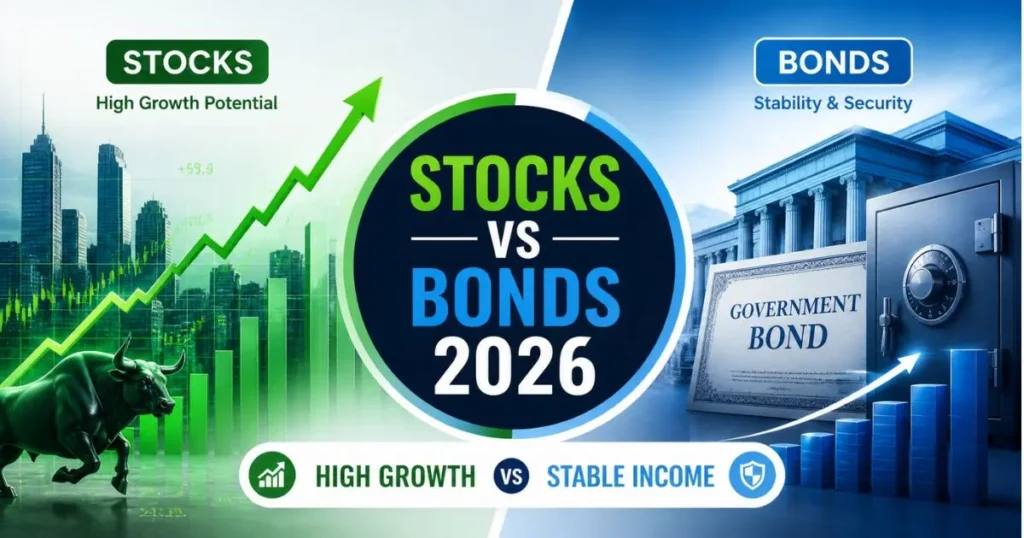
Investing is one of the most effective ways to build wealth over time. However, for many beginners, choosing between stocks and bonds can feel confusing. Both are popular investment options, but they serve different purposes and come with different levels of risk and return.
In this detailed guide, we will break down stocks vs bonds in a simple and professional way so that you can make informed investment decisions in 2026 and beyond.
What Are Bonds?
Bonds are a type of investment where you lend your money to a government or a company, and in return, they pay you fixed interest at regular intervals and return your original amount at maturity.
How Bonds Work
- You invest a certain amount (principal)
- The issuer pays you interest (coupon) periodically
- At the end of the bond period, you get back your principal amount
Example
If you buy a bond worth ₹10,000 with 7% annual interest for 5 years, you’ll earn regular interest, and after 5 years, you’ll receive your ₹10,000 back.
What Are Stocks?
Stocks represent ownership in a company. When you buy a stock, you are purchasing a small share of that business.

How Stocks Work
- Companies issue stocks to raise capital
- Investors buy shares expecting growth and profit
- You earn money through:
- Capital appreciation (price increase)
- Dividends (profit sharing)
Example
If you buy shares of a company at ₹100 and the price rises to ₹150, your profit is ₹50 per share.
Morningstar – Long-Term Stock and Bond Returns
How Do Stocks Work?
- If the company grows, the stock price may rise
- You can earn money by selling stocks at a higher price
- Some companies also pay dividends from profits
Key Features
- Higher return potential
- Market-linked and risky
- Best for long-term wealth creation
Stocks vs Bonds: Key Differences
| Feature | Stocks | Bonds |
|---|---|---|
| Type of Investment | Ownership in a company | Loan to government or company |
| Returns | High potential (long term) | Stable and predictable |
| Risk Level | High (market volatility) | Low to moderate |
| Income Source | Dividends + capital gains | Fixed interest income |
| Capital Safety | Not guaranteed | Usually protected at maturity |
| Inflation Protection | High (long term) | Low to moderate |
| Liquidity | High (easy to buy/sell) | Moderate |
| Best For | Long-term wealth creation | Stability and regular income |
“If you want to make the most of your earnings, check out this guide on how to save money from your salary with 10 practical tips that actually work.”
Stocks vs Bonds: Returns
Stocks generally offer higher returns over the long term because they are linked to a company’s growth and profits. On average, stocks can deliver 10–14% annual returns, but prices may rise and fall sharply in the short term.
Bonds provide stable and predictable returns through fixed interest payments. Most bonds offer 6–8% annual returns, with much lower risk compared to stocks.
Risk Comparison
Stock Risks
- Market volatility
- Company performance issues
- Economic downturns
Bond Risks
- Interest rate risk
- Inflation risk
- Credit/default risk
Stocks are riskier but reward you more. Bonds are safer but offer limited.
Liquidity: Which is Easier to Sell?
- Stocks: Highly liquid (can be sold anytime during market hours)
- Bonds: Less liquid, especially long-term bonds
Stocks are better if you need quick access to money.
Investment Goals: When to Choose Stocks or Bonds
Choose Stocks If:
- You want long-term wealth creation
- You can tolerate market ups and downs
- Your investment horizon is 5+ years
Choose Bonds If:
- You want regular income
- You prefer low risk
- You are nearing retirement
Stocks vs Bonds for Beginners
If you are just starting your investment journey:
- Start small
- Avoid putting all money in one option
- Focus on long-term goals
- Start with equity mutual funds (SIP) instead of direct stocks
- Allocate a portion to debt funds or bonds for stability
A balanced mix reduces risk and builds confidence.
“If you want to go a step deeper into mutual fund categories, understanding Equity vs Debt Funds: Differences & Which is Better in 2026 will help you clearly see how risk and returns differ within fund-based investing.”
Ideal Portfolio Allocation (2026 Strategy)
A simple rule many investors follow:
- Age-based formula:
Equity (%) = 100 – Your Age
Bonds (%) = Your Age
Example:
If you are 30 years old:
- Stocks: 70%
- Bonds: 30%
Impact of Inflation
Stocks
Stocks usually beat inflation over time because companies grow and increase profits.
Bonds
Fixed returns may lose value due to inflation, especially if inflation is higher than interest rates.
Stocks are better for long-term purchasing power.
Taxation in India (2026)
Stocks
- Short-Term Capital Gains (STCG): 15%
- Long-Term Capital Gains (LTCG): 10% above ₹1 lakh
Bonds
- Interest income is taxed as per your income slab
- Capital gains depend on holding period
Stocks are often more tax-efficient for long-term investors.
Pros and Cons
Advantages of Stocks
- High return potential
- Beat inflation
- Ownership in businesses
Disadvantages of Stocks
- High risk
- Market volatility
Advantages of Bonds
- Stable income
- Lower risk
- Predictable returns
Disadvantages of Bonds
- Lower returns
- Inflation impact
Stocks vs Bonds: Which is Better?
There is no single winner in the stocks vs bonds debate—it depends on your financial goals, time horizon, and risk tolerance.
Groww – Bonds vs Stocks: Key Differences Explained
- Stocks are better if you want long-term wealth creation, can handle market ups and downs, and have time to stay invested. They offer higher growth potential but come with higher risk.
- Bonds are better if you want safety, steady income, and lower risk. They help protect capital and reduce portfolio volatility, especially during market downturns.
Stocks vs Bonds Over Time
Over time, stocks and bonds play very different roles, and history makes this clear. Stocks grow faster because they are driven by business growth and profits. While stock prices swing in the short term, decades of compounding have helped stocks deliver higher long-term returns, making them ideal for wealth creation, especially for young investors.
Bonds move slower but steadier. They generate regular interest income, protect capital during market downturns, and add stability to a portfolio—even though their returns are lower than stocks.
Key Insight Over Time:
- Short term: Bonds stay stable, stocks fluctuate
- Long term: Stocks outperform bonds
- Best approach: Use stocks for growth and bonds for stability to build a stronger, stress-free portfolio.
“If you are confused about how to invest—regularly or as a one-time amount—understanding SIP vs Lumpsum: Which is Better Investment in 2026? Returns, Risk & Tax will help you choose the right strategy for your portfolio.”
Stocks vs Bonds vs Mutual Funds – Comparison Table
| Feature | Stocks | Bonds | Mutual Funds |
|---|---|---|---|
| Meaning | Ownership in a company | Lending money to govt/company | Pooled investment managed by professionals |
| Risk Level | High | Low to Moderate | Low to High (depends on fund type) |
| Return Potential | High (long-term) | Stable but limited | Moderate to High |
| Income Type | Dividends & capital gains | Fixed interest income | Dividends & capital appreciation |
| Market Volatility | High | Low | Moderate |
| Diversification | Low (single stock risk) | Moderate | High |
| Best For | Long-term wealth creation | Safety & steady income | Beginners & goal-based investing |
| Investment Control | Full control | Limited | Managed by fund manager |
| Liquidity | High | Moderate | High (open-ended funds) |
| Skill Required | High | Low | Low |
Smart Investment Strategy
Instead of choosing one, follow a balanced portfolio approach:
- 60–80% in stocks (for growth)
- 20–40% in bonds (for stability)
This helps you:
- Reduce risk
- Maintain consistent returns
- Handle market volatility better
Common Mistakes to Avoid
- Investing all money in stocks without understanding risk
- Ignoring bonds completely
- Panic selling during market crashes
- Not diversifying your portfolio
Conclusion
In the stocks vs bonds debate, there is no single winner. Stocks are powerful tools for long-term wealth creation, while bonds offer safety and steady income. Stocks help your money grow, but bonds help you sleep peacefully.
Related Article
- How to Invest in US Stocks from India (2026)
- How to Invest in Bonds in India: Beginner Guide
- Best Long Term Investment Stocks in India
- Best Low-Risk Mutual Funds in India 2026
Frequently Asked Questions (FAQs)
Q1. What is the difference between stocks vs bonds?
Stocks give ownership, while bonds are loans with fixed interest.
Q2. Is it better to invest in stocks or bonds?
It depends on your goal:
Stocks: Better for long-term wealth growth but come with higher risk
Bonds: Better for safety and stable income but give lower returns
Q3. Why would someone buy a bond instead of stock?
Someone buys bonds instead of stocks because they offer safer, fixed returns with lower risk, making them ideal for capital protection and steady income.
Q4. What is the safest form of investment?
The safest form of investment is usually government-backed bonds, as they carry very low risk of loss but also provide lower returns compared to other options.
Q5. Do bonds give guaranteed returns?
Most bonds offer predictable returns, but not all are risk-free.
Q6. Should I move my stocks to bonds?
ou should move from stocks to bonds only if you want lower risk, stable returns, or are nearing your financial goal (like retirement). Otherwise, staying in stocks helps for long-term growth.
Q7. What are the disadvantages of a bond?
Bonds have lower returns compared to stocks, are affected by inflation, and may offer limited growth potential, especially for long-term wealth building.
Q8. How much should I invest in stocks vs bonds?
It depends on age and risk profile. Young investors can invest more in stocks, while older investors should prefer bonds.
Q9. What is the 7% rule in stocks?
The 7% rule in stocks is a simple risk management idea that suggests you should sell a stock if it falls around 7% below your buying price to limit losses and protect your capital.
Q10. What is the 5% rule on bonds?
The 5% rule in bonds suggests that an investor should avoid concentrating more than 5% of their total portfolio in a single bond or issuer to reduce risk and ensure proper diversification.