

Many people in India dream of a stress-free life where money is not a daily worry. This is called financial freedom — having enough savings, investments, and passive income to cover your expenses without depending only on a salary.
In 2026, rising costs of education, healthcare, and living make it important to learn how to achieve financial freedom in India. The good news is that anyone — salaried, business owner, freelancer, or student — can achieve it with a clear plan, discipline, and smart money habits.
In this complete guide, you will learn simple steps to achieve financial freedom in India in easy language.
What is Financial Freedom?
Financial freedom means your income from investments and assets is more than your monthly expenses. In simple words, your money works for you.
It does not mean you stop working. It means you work because you want to, not because you must.
Signs You Are Financially Free
- No high-interest debt
- Emergency fund ready
- Regular investment income
- Multiple income sources
- Retirement savings on track
Why is Financial Freedom Important in India?
India is a fast-growing country. But job security is not guaranteed. Inflation reduces the value of money every year. Medical costs are also rising.
Here are some reasons why financial freedom in India matters:
- Protection from job loss
- Freedom to start a business
- Stress-free retirement
- Better lifestyle choices
- Financial security for family
Step-by-Step Plan to Achieve Financial Freedom in India
1. Set Clear Financial Goals
The first step to achieve financial freedom in India is setting clear goals.
Ask yourself:
- When do I want to retire?
- How much money do I need every month?
- What lifestyle do I want?
Write short-term and long-term goals. This gives direction to your money.
2. Understand Your Monthly Expenses
Track your income and expenses for at least three months.
Divide expenses into:
- Needs (rent, food, bills)
- Wants (shopping, travel)
- Investments
Knowing your numbers is important for financial planning.
3. Create a Smart Budget
Follow the 50/30/20 rule:
- 50% for needs
- 30% for wants
- 20% for savings and investments
If possible, increase your savings rate to 30% or more. A higher savings rate helps you reach financial freedom faster.
4. Build an Emergency Fund
Before investing, create an emergency fund.
Save at least 6 months of expenses in:
- Savings account
- Liquid mutual fund
- Fixed deposit
This fund protects you from sudden job loss or medical emergencies.
5. Avoid and Clear Debt
High-interest debt like credit card loans can delay financial freedom.
Steps to manage debt:
- Pay highest interest loan first
- Avoid unnecessary EMI purchases
- Do not take personal loans for luxury items
Debt-free life is the foundation of financial independence.
6. Start Investing Early
Investing is the most important step to achieve financial freedom in India.
Saving alone is not enough. You must grow your money.
Best Investment Options in India
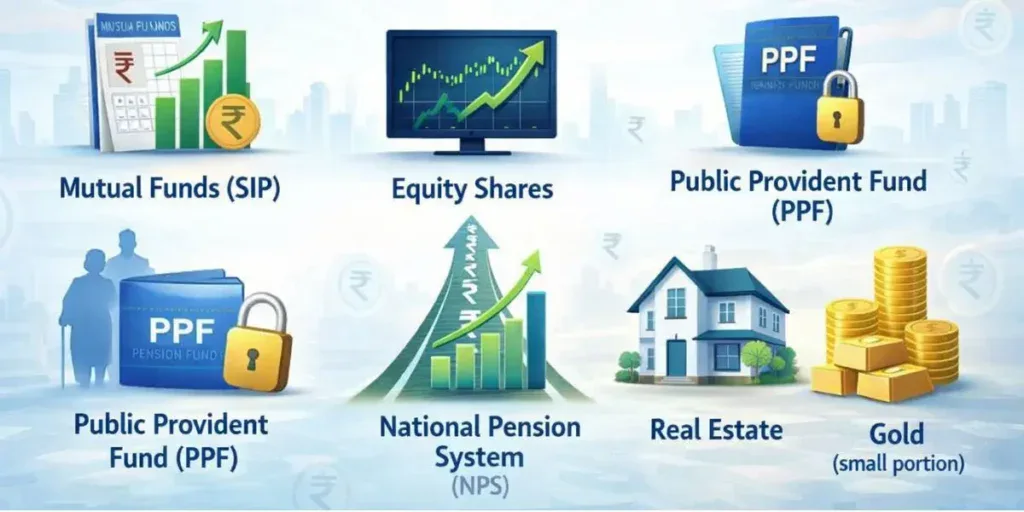
- Mutual Funds (SIP)
- Equity Shares
- Public Provident Fund (PPF)
- National Pension System (NPS)
- Real Estate
- Gold (in small portion)
Systematic Investment Plan (SIP) in equity mutual funds is popular for long-term wealth building.
If you want to optimize both your retirement and tax savings, this NPS vs PPF: Which is Better Investment for Retirement in India? guide will be useful for you.
7. Use Power of Compounding
Compounding means earning returns on your returns.
Example:
If you invest ₹10,000 monthly at 12% return for 20 years, you can build a large retirement corpus.
The earlier you start, the bigger your wealth grows.
Time is more powerful than money.
8. Increase Your Income
Cutting expenses has limits. Increasing income has no limit.
Ways to increase income in India:
- Learn high-income skills
- Start a side hustle
- Freelancing
- Blogging or YouTube
- Online business
- Rental income
Multiple income sources reduce financial risk.
9. Invest in Passive Income
Passive income helps you achieve financial freedom faster.
Examples:
- Dividend stocks
- Rental property
- REITs
- Bonds
- Online digital products
When passive income covers monthly expenses, you are financially free.
10. Plan for Retirement Early
Retirement planning is very important.

Start Financial Planning Now (Bajaj Finserv)
Ask:
- How much money do I need for retirement?
- At what age do I want to retire?
Use retirement calculators to estimate your target corpus.
Invest in:
- NPS
- EPF
- Equity mutual funds
- Long-term stocks
Early planning reduces pressure later.
If you are new and want retirement planning, this Retirement Planning in India for Beginners: Step-by-Step Guide will walk you through everything you need to know.
11. Protect Your Wealth
Financial freedom is not only about earning. It is also about protecting.
Important protections:
- Health insurance
- Term life insurance
- Nominee updates
- Proper documentation
Insurance protects your family from financial crisis.
12. Review and Rebalance Investments
Review your portfolio every year.
- Check asset allocation
- Rebalance equity and debt
- Remove poor-performing investments
Regular review keeps your plan on track.
How Much Money Do You Need for Financial Freedom in India?
There is a simple formula:
Annual Expenses × 25 = Financial Freedom Number
Example:
If your yearly expense is ₹6 lakh, you need around ₹1.5 crore invested.
This is based on the 4% rule, where you withdraw 4% yearly from investments.
Your number may vary based on lifestyle and inflation.
Common Mistakes to Avoid
- Starting investment late
- Depending only on fixed deposits
- No emergency fund
- Ignoring inflation
- Spending more as income increases
- No retirement planning
Avoiding these mistakes helps you reach financial freedom faster.
Financial Freedom for Salaried Employees in India
If you are a salaried person:
- Increase SIP every year
- Invest bonuses wisely
- Avoid lifestyle inflation
- Use tax-saving investments
Discipline and long-term mindset are key.
Financial Freedom for Business Owners
If you run a business:
- Separate business and personal money
- Create emergency reserves
- Invest profits outside business
- Plan retirement separately
Diversification reduces risk
Simple Checklist to Achieve Financial Freedom in India
- Clear goals
- Budget planning
- Emergency fund
- Debt-free life
- Regular SIP investment
- Passive income
- Retirement planning
- Insurance coverage
- Annual review
Follow this checklist consistently.
Conclusion
Financial freedom in India is not a dream. It is a result of planning, discipline, and smart investing. You do not need a huge salary to achieve it. You need patience, regular savings, and long-term thinking.
Start small. Invest regularly. Increase your income. Avoid debt. Protect your family. Review your plan every year.
If you follow these simple steps, you can achieve financial freedom in India and live a stress-free life in 2026 and beyond.
Your journey starts today.
Read more:
- Best Side Hustle for Students: 15 Smart Ways to Earn While Studying
- Retirement Planning in India (2026)
- How to Build Wealth in Your 40s: 7 Proven Strategies for Financial Freedom
- Best Low-Risk Mutual Funds in India 2026
Frequently Asked Questions (FAQs)
Q1. What is financial freedom in India?
Financial freedom in India means having enough savings and passive income to cover all expenses without depending on a job.
Q2. How can a beginner achieve financial freedom?
A beginner can start by budgeting, building an emergency fund, investing through SIP, and avoiding debt.
Q3. How much money is needed for financial freedom in India?
It depends on lifestyle. Usually, 25 times your annual expenses is considered a safe target.
Q4. Is SIP enough for financial freedom?
SIP in equity mutual funds can help build long-term wealth. But combining it with other investments is better.
Q5. Can I achieve financial freedom with a small salary?
Yes. With disciplined saving, smart investing, and increasing income, even small earners can achieve financial freedom in India.
Q6. Is Financial Freedom Possible by 40 in India?
Yes, it is possible.
But you need:
- High savings rate (40%+)
- Smart investing
- Multiple income streams
- Controlled lifestyle
Early retirement requires strong discipline.