
Learn how to invest in bonds in India with this beginner-friendly 2026 guide covering types, returns, risks, and simple steps to get started.
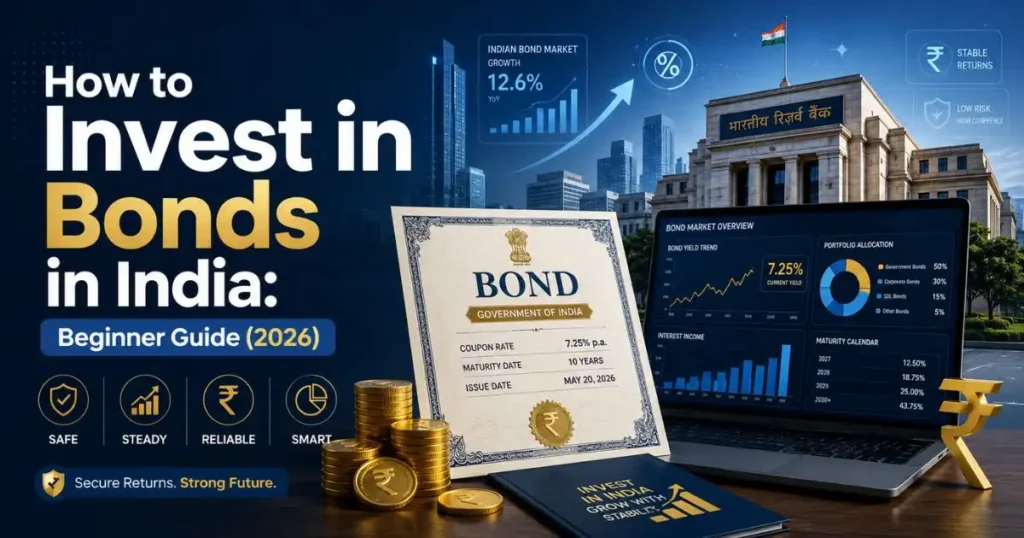
If you are looking for a safe and stable way to grow your money in 2026, investing in bonds in India can be a smart choice. Bonds are fixed-income instruments that offer regular interest payments and are generally considered less risky compared to stocks, making them ideal for beginners who want steady returns with lower volatility.
In this beginner-friendly guide, you will learn how to invest in bonds in India step by step, including the different types of bonds such as government bonds, corporate bonds, and tax-free bonds. We will also cover how bonds work, expected returns, risks involved, and the best ways to start investing even with a small amount.
Whether you are a new investor or someone looking to diversify your portfolio beyond mutual funds and equities, this 2026 guide will help you understand everything you need to confidently start your bond investment journey in India.
What Are Bonds?
A bond is a type of loan. When you buy a bond, you are lending money to the government or a company. In return, they promise to pay you interest and return your money after a fixed time.

Example:
If you invest ₹10,000 in a bond at 7% interest, you will earn ₹700 every year until maturity.
Why Should You Invest in Bonds in India?
1. Safe Investment Option
Bonds are safer than stocks, especially government bonds.
2. Fixed Income
You get regular interest income.
3. Less Risk
Bonds are less volatile compared to equity investments.
4. Diversification
Adding bonds to your portfolio reduces overall risk.
Types of Bonds in India
1. Government Bonds
These are issued by the Government of India. They are very safe.
2. Corporate Bonds
Issued by companies. They offer higher returns but slightly higher risk.

3. Tax-Free Bonds
Interest earned is tax-free. Good for high-income investors.
4. RBI Bonds
Issued by RBI with fixed interest rates.
5. Municipal Bonds
Issued by local government bodies.
How to Invest in Bonds in India: Step-by-Step Guide
Step 1: Set Your Investment Goal
Before investing, decide why you want to invest.
- Regular income
- Capital safety
- Long-term savings
Step 2: Choose the Right Type of Bond
Select bonds based on your risk level:
- Low risk → Government bonds
- Medium risk → Corporate bonds
Step 3: Open a Demat Account
To invest in bonds in India, you need a Demat account.
You can open it with brokers like:
Agar aap Upstox par Demat account kholna chahte hain, to yahaan click karein.
Step 4: Select a Platform
You can invest through:
If you want to invest directly in government bonds without a broker, you can use the official RBI Retail Direct platform, which allows retail investors to buy bonds easily.
Step 5: Analyze the Bond
Before investing, check:
- Interest rate (coupon rate)
- Credit rating (AAA, AA, etc.)
- Maturity period
Step 6: Invest in the Bond
Once you select a bond, place an order through your platform.
Step 7: Track Your Investment
Keep checking your bond performance and interest payments.
Where to Buy Bonds in India

1. RBI Retail Direct
You can directly buy government bonds.
2. Stock Market
Bonds are listed on NSE and BSE.
3. Online Platforms
Websites like GoldenPi and Wint Wealth make bond investing easy.
Minimum Investment in Bonds
The minimum investment depends on the type of bond:
- Government bonds: ₹10,000 (approx.)
- Corporate bonds: ₹1,000 to ₹10,000
- Platforms: Starting from ₹1,000
Returns on Bonds in India (2026)
Bond returns depend on type and risk:
- Government bonds: 6%–7.5%
- Corporate bonds: 7%–10%
- Tax-free bonds: 5%–6%
If your goal is long-term wealth creation, you can pair bond investments with the Best Mutual Fund Portfolio for Long Term 2026 – Grow Wealth Safely for better financial growth.
Risks of Investing in Bonds
1. Interest Rate Risk
If interest rates rise, bond prices fall.
2. Credit Risk
Company may fail to pay interest.
3. Liquidity Risk
Some bonds are hard to sell quickly.
Taxation on Bonds in India
- Interest income → Taxed as per your income slab
- Capital gains →
- Short-term: taxed as per slab
- Long-term: 10% or 20% (depending on bond type)
Bonds vs Fixed Deposits
| Feature | Bonds | Fixed Deposits |
|---|---|---|
| Returns | Higher | Moderate |
| Risk | Medium | Low |
| Liquidity | Moderate | Low |
| Tax | Taxable | Taxable |
Common Mistakes to Avoid
- Not checking credit rating
- Investing all money in one bond
- Ignoring maturity period
- Not understanding risks
Conclusion
Now you understand how to invest in bonds in India step by step. Bonds are a great option for beginners who want stable income and low risk. By choosing the right bonds and following a smart strategy, you can grow your money safely.
Start small, learn slowly, and build a balanced portfolio with bonds, stocks, and mutual funds.
Related Articles:
- Top 5 Best Mutual Funds for Lumpsum Investment 2026 in India
- Best Low-Risk Mutual Funds in India 2026
- Equity vs Debt Funds: Which is Better in 2026?
- Top Tax Saving Mutual Funds (ELSS) in India
FAQs
Q1. What is the minimum amount to invest in bonds in India?
You can start investing with as low as ₹1,000 depending on the platform.
Q2. Are bonds safe in India?
Yes, government bonds are very safe. Corporate bonds carry some risk.
Q3. Can I sell bonds before maturity?
Yes, you can sell them in the secondary market.
Q4. Which bond is best to invest in India?
Government bonds or AAA-rated corporate bonds are best.
Q5. Is bond interest taxable?
Yes, interest is taxed as per your income slab.
Q6. How to invest in bonds in India without a broker?
You can use RBI Retail Direct platform.
Q7. How can I buy bonds in India?
You can buy bonds in India through platforms like the RBI Retail Direct for government bonds or through stock exchanges like the National Stock Exchange of India and Bombay Stock Exchange using a Demat account. You can also invest via online bond platforms that offer easy access to corporate bonds.
Q8. Which is better, FD or bonds?
FDs are safer, while bonds can give higher returns.