Confused about whether to file ITR-1, ITR-2, ITR-3, or ITR-4 for AY 2026-27? This guide explains the eligibility, income sources, latest changes, and key differences between each ITR form to help you choose the right Income Tax Return with confidence.
Filing your Income Tax Return (ITR) is an important responsibility for every taxpayer in India. However, selecting the correct ITR form can be confusing, especially if you have multiple income sources such as salary, capital gains, rental income, or business profits. Filing the wrong ITR form may result in delays in processing, defective return notices, or additional compliance requirements.
For Assessment Year (AY) 2026-27, the Income Tax Department has introduced important updates to the ITR forms, including revised eligibility for certain taxpayers with long-term capital gains under Section 112A. Understanding these changes is essential to ensure accurate tax filing.
In this guide, you’ll learn the differences between ITR-1, ITR-2, ITR-3, and ITR-4, who should file each form, the latest AY 2026-27 updates, and practical examples to help you choose the correct Income Tax Return form.
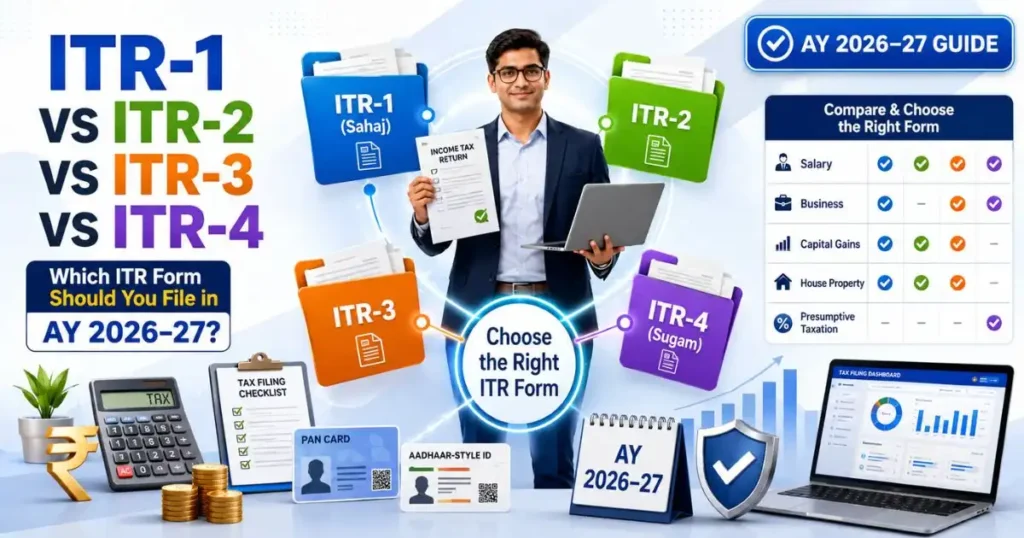
Quick Comparison: ITR-1 vs ITR-2 vs ITR-3 vs ITR-4 (AY 2026-27)
| Feature | ITR-1 (Sahaj) | ITR-2 | ITR-3 | ITR-4 (Sugam) |
|---|---|---|---|---|
| Salaried Employees | ✅ | ✅ | ✅ | ✅ |
| Pension Income | ✅ | ✅ | ✅ | ✅ |
| Business Income | ❌ | ❌ | ✅ | ✅ (Presumptive only) |
| Professional Income | ❌ | ❌ | ✅ | ✅ (Presumptive) |
| Capital Gains | Limited LTCG under Section 112A (subject to conditions) | ✅ | ✅ | Limited LTCG under Section 112A (subject to conditions) |
| Multiple House Properties | ❌ | ✅ | ✅ | ❌ |
| Foreign Assets | ❌ | ✅ | ✅ | ❌ |
| Partnership Firm Partner | ❌ | ❌ | ✅ | ❌ |
| Presumptive Taxation | ❌ | ❌ | ❌ | ✅ |
| Best For | Salaried Individuals | Investors | Businesses & Professionals | Small Businesses |
Let’s Understand Different Types of ITR Forms
1. ITR-1 (Sahaj)
ITR-1, also known as Sahaj, is the simplest Income Tax Return form. It is primarily meant for resident individuals with straightforward income sources.
If you are a salaried employee, receive pension income, or earn limited income from other sources, ITR-1 is often the appropriate choice.
Who Can File ITR-1 for AY 2026-27?
You can file ITR-1 (Sahaj) if all of the following conditions are met:
- You are a Resident Individual.
- Your total income does not exceed ₹50 lakh during the financial year.
- Your income comes from one or more of the following:
- Salary or pension
- Income from one house property (excluding cases involving carried-forward losses)
- Income from other sources, such as interest from savings accounts, fixed deposits, or family pension (excluding lottery winnings and racehorse income)
- Agricultural income up to ₹5,000
- You have long-term capital gains (LTCG) under Section 112A up to ₹1.25 lakh, with no capital losses to carry forward or set off, and you satisfy all other prescribed conditions for using ITR-1.
Example
Rahul works in a private company and earns:
- Salary: ₹18 lakh
- Bank Interest: ₹45,000
- One self-occupied house
- LTCG from listed equity shares: ₹90,000 under Section 112A
Since his total income is below ₹50 lakh, he is a resident individual, and he meets the prescribed conditions, Rahul can file ITR-1 for AY 2026-27.
Income Covered Under ITR-1
ITR-1 can generally be used for the following income sources:
Salary Income
This includes:
- Basic Salary
- Dearness Allowance (DA)
- House Rent Allowance (HRA)
- Bonus
- Leave Travel Allowance (LTA)
- Other taxable allowances
Pension Income
Government and private pension received after retirement is also covered under ITR-1, subject to the eligibility conditions.
Income from One House Property
You can report:
- Self-occupied property
- Let-out property (subject to the form’s conditions and without carried-forward house property losses)
Income from Other Sources
Examples include:
- Savings account interest
- Fixed Deposit (FD) interest
- Recurring Deposit (RD) interest
- Family pension
- Dividend income (where otherwise eligible)
Agricultural Income
Agricultural income up to ₹5,000 can be reported in ITR-1.
Who Cannot File ITR-1?
You cannot use ITR-1 if you:
- Have business or professional income
- Own more than one house property
- Have foreign assets or signing authority in a foreign account
- Are a Non-Resident (NR) or Resident but Not Ordinarily Resident (RNOR)
- Have capital gains that are not eligible to be reported in ITR-1
- Have agricultural income exceeding ₹5,000
- Are a director in a company or hold certain unlisted equity shares where the form instructions require a different ITR
If any of these situations apply, you may need to file ITR-2, ITR-3, or ITR-4, depending on your income sources and eligibility.
2. ITR-2
ITR-2 is meant for individuals and Hindu Undivided Families (HUFs) who do not have income from business or profession, but have more complex income sources than those covered under ITR-1.
If you earn income from capital gains, multiple house properties, foreign assets, or a higher income, ITR-2 is usually the correct return form.
Who Can File ITR-2 for AY 2026-27?
You can file ITR-2 if you are an Individual or HUF and any of the following applies:
- Your total income is more than ₹50 lakh
- You have income from salary or pension
- You own more than one house property
- You have short-term or long-term capital gains
- You have invested in shares, mutual funds, property, gold, or other capital assets
- You have foreign assets or foreign income
- You are a Resident, RNOR, or Non-Resident (NR) (subject to the applicable tax provisions)
- You are a director in a company
- You own unlisted equity shares
- You receive income from other sources that is not eligible for ITR-1
Important: If you have business or professional income, you generally cannot use ITR-2. In such cases, ITR-3 is usually applicable.
Example
Neha is employed by an MNC and earns:
- Salary: ₹28 lakh
- Rental income from two house properties
- Long-term capital gains from equity mutual funds: ₹3 lakh
- Interest income: ₹80,000
Since she has multiple house properties and capital gains, ITR-2 is the correct form for her.
Income Covered Under ITR-2
ITR-2 allows taxpayers to report multiple types of income.
1. Salary or Pension
Includes:
- Basic salary
- HRA
- Special allowance
- Bonus
- Pension
- Perquisites
2. Income from House Property
You can report:
- One house property
- Multiple house properties
- Self-occupied properties
- Let-out properties
3. Capital Gains
ITR-2 covers capital gains from:
- Sale of shares
- Mutual funds
- Real estate
- Gold
- Bonds
- Other capital assets
Both Short-Term Capital Gains (STCG) and Long-Term Capital Gains (LTCG) can be reported.
4. Income from Other Sources
Such as:
- Savings account interest
- Fixed deposit interest
- Dividend income
- Family pension
- Lottery income (where applicable)
5. Foreign Income and Assets
ITR-2 is also applicable if you have:
- Foreign bank accounts
- Overseas investments
- Foreign shares
- Foreign property
- Foreign income taxable in India
Who Cannot File ITR-2?
You cannot use ITR-2 if you have:
- Business income
- Freelancing income
- Professional income
- Proprietorship business income
In such situations, you generally need to file ITR-3.
3. ITR-3
ITR-3 is designed for individuals and HUFs who earn income from business or profession.
It is the most comprehensive ITR form among the four discussed in this article.
If you run a business, work as a freelancer, or operate as a consultant, ITR-3 is often the right choice.
Who Can File ITR-3?
ITR-3 is applicable if you have income from:
- Proprietorship business
- Freelancing
- Professional practice
- Trading business
- Manufacturing business
- Online business
- Digital marketing agency
- Consultancy services
It is also used by:
- Chartered Accountants
- Doctors
- Lawyers
- Architects
- Engineers
- Interior Designers
- Freelance writers
- Bloggers
- YouTubers
- Influencers
- Software developers
- Stock traders
- F&O traders
Example
Amit is a freelance web developer.
His annual income consists of:
- Freelancing income: ₹22 lakh
- Savings interest: ₹35,000
- Long-term capital gains: ₹90,000
Since he earns professional income, he should file ITR-3 (unless he is eligible for and opts for the presumptive taxation scheme under ITR-4).
Income Covered Under ITR-3
ITR-3 can include:
Business Income
For example:
- Retail shop
- Trading
- Manufacturing
- Online store
- Service business
Professional Income
Examples:
- CA
- Doctor
- Advocate
- Engineer
- Freelancer
- Consultant
Salary Income
If you receive both salary and business income, both can be reported.
House Property Income
Includes:
- Self-occupied house
- Rental income
- Multiple house properties
Capital Gains
Income from:
- Stocks
- Mutual funds
- Property
- Gold
- Bonds
- Other investments
Other Sources
Such as:
- Interest income
- Dividend income
- Family pension
4. ITR-4 (Sugam)
ITR-4, also known as Sugam, is meant for small businesses and professionals who opt for the presumptive taxation scheme under the Income-tax Act.
It simplifies tax compliance by allowing eligible taxpayers to declare income at prescribed rates instead of maintaining detailed books of account.
Who Can File ITR-4?
You may file ITR-4 if:
- You are a Resident Individual, HUF, or Partnership Firm (excluding LLPs)
- Your total income does not exceed ₹50 lakh
- You opt for the presumptive taxation scheme under:
- Section 44AD (eligible businesses)
- Section 44ADA (specified professionals)
- Section 44AE (goods carriage business)
- You have income from:
- Salary or pension
- One house property
- Other sources (such as interest)
- You have eligible LTCG under Section 112A, subject to the conditions prescribed for ITR-4 for AY 2026-27.
Example
Priya is a freelance graphic designer.
Her income includes:
- Professional receipts: ₹24 lakh
- She opts for Section 44ADA
- FD interest: ₹30,000
Since she is eligible for the presumptive taxation scheme under Section 44ADA, ITR-4 is generally the appropriate form.
Who Cannot File ITR-4?
ITR-4 is not applicable if you:
- Have income exceeding ₹50 lakh
- Own foreign assets
- Have more than one house property
- Are a company director
- Are a partner earning income from a partnership firm (partners generally file ITR-3)
- Do not opt for the presumptive taxation scheme
- Have business income that requires regular books of account
What is an ITR Form?
An Income Tax Return (ITR) form is an official document used to report your income, deductions, taxes paid, and tax liability to the Income Tax Department of India.
Different taxpayers have different income sources. Because of this, the Income Tax Department provides multiple ITR forms.
For example:
- Salaried employees generally file ITR-1 or ITR-2.
- Freelancers and professionals often use ITR-3 or ITR-4.
- Business owners may need ITR-3 or ITR-4, depending on their taxation method.
- Investors with capital gains usually file ITR-2 or ITR-3.
Using the correct form helps ensure faster processing of your return and reduces the chances of receiving notices from the tax department.
How to Choose the Correct ITR Form for AY 2026-27
Choosing the right ITR form is easier when you identify your primary source of income. Follow the guide below to determine which form is most suitable for your situation.
Step 1: Are You a Salaried Employee or Pensioner?
If your income comes only from:
- Salary or pension
- One house property
- Interest income
- Agricultural income up to ₹5,000
- Eligible LTCG under Section 112A within the prescribed limit for ITR-1
Choose: ITR-1 (Sahaj)
Step 2: Do You Have Capital Gains or Multiple House Properties?
If you:
- Sold shares or mutual funds
- Sold property
- Own more than one house property
- Have foreign assets or foreign income
- Are a company director
- Hold unlisted equity shares
Choose: ITR-2
Step 3: Do You Run a Business or Work as a Freelancer?
If you earn income from:
- Proprietorship business
- Freelancing
- Consulting
- Blogging
- YouTube
- Digital marketing
- Professional practice
Choose: ITR-3
Step 4: Are You Using the Presumptive Taxation Scheme?
If you:
- Run a small business under Section 44AD
- Are an eligible professional under Section 44ADA
- Operate a goods carriage business under Section 44AE
and satisfy the prescribed conditions,
Choose: ITR-4 (Sugam)
Which ITR Form Should You File?
| Your Situation | Recommended ITR Form |
|---|---|
| Salaried employee with income up to ₹50 lakh and simple income sources | ITR-1 |
| Salaried employee with capital gains | ITR-2 |
| Salaried employee with multiple house properties | ITR-2 |
| Freelancer or Consultant | ITR-3 (or ITR-4 if eligible and opting for presumptive taxation) |
| Proprietorship Business | ITR-3 |
| Small Business under Section 44AD | ITR-4 |
| Doctor under Section 44ADA | ITR-4 (if opting for presumptive taxation) |
| Investor with foreign assets | ITR-2 |
| Partner in a Partnership Firm | ITR-3 |
Latest Changes in ITR Forms for AY 2026-27
The Income Tax Department has introduced a few important changes for AY 2026-27. Here are some key updates taxpayers should know before filing their returns.
1. Limited LTCG Now Allowed in ITR-1 and ITR-4
One of the biggest updates is that certain taxpayers can now continue using ITR-1 or ITR-4 even if they have Long-Term Capital Gains (LTCG) under Section 112A, provided:
- The gains are within the prescribed limit for the form.
- There are no capital losses to carry forward or set off.
- All other eligibility conditions are satisfied.
This change benefits many salaried employees and small business owners who invest in equity shares or equity mutual funds.
2. Improved Disclosure Requirements
The updated ITR forms require additional disclosures in certain cases, including:
- Deductions claimed
- Exempt income
- Tax payments
- TDS and TCS details
- Bank account information for refunds
Taxpayers should carefully verify all pre-filled information before submitting the return.
3. Better Integration with AIS and Form 26AS
The Income Tax Department continues to improve integration with:
- Annual Information Statement (AIS)
- Form 26AS
- Taxpayer Information Summary (TIS)
This helps taxpayers reconcile income and taxes before filing, reducing mismatches.
4. Enhanced Verification of Financial Transactions
High-value financial transactions, including certain investments and property transactions, are increasingly reflected in AIS. Taxpayers should review these details and ensure that their ITR accurately matches the available information.
Common Mistakes to Avoid While Filing ITR
Many taxpayers make simple mistakes that can delay refunds or trigger notices from the Income Tax Department.
Here are some of the most common ones.
1. Selecting the Wrong ITR Form
This is the most frequent mistake.
Always choose the form based on your:
- Income sources
- Residential status
- Capital gains
- Business income
- Presumptive taxation eligibility
2. Ignoring AIS and Form 26AS
Many taxpayers file returns without checking:
- Form 26AS
- AIS
- TIS
Always reconcile these records with your income before filing.
3. Forgetting Interest Income
Don’t forget to report:
- Savings account interest
- Fixed Deposit interest
- Recurring Deposit interest
- Income from other taxable deposits
Banks report this information to the Income Tax Department.
4. Not Reporting Capital Gains
Even if Tax Deducted at Source (TDS) has been deducted or your gains are small, you must report capital gains where applicable.
5. Claiming Incorrect Deductions
Claim deductions only if you are eligible.
Examples include:
- Section 80C
- Section 80D
- Section 80CCD(1B)
- Home loan interest, where applicable
Keep supporting documents in case the department requests verification.
6. Not Verifying the Return
Filing your ITR is not complete until it is verified.
You can verify your return using:
- Aadhaar OTP
- Net Banking
- Demat Account
- Bank Account EVC
- Digital Signature Certificate (where applicable)
Documents Required Before Filing Your ITR
Keep the following documents ready to make the filing process smoother:
- PAN Card
- Aadhaar Card
- Form 16 (for salaried employees)
- Form 26AS
- Annual Information Statement (AIS)
- Taxpayer Information Summary (TIS)
- Salary slips
- Bank statements
- Interest certificates
- Capital gains statements from brokers or mutual fund platforms
- Home loan interest certificate (if applicable)
- Investment proof for deductions
- Health insurance premium receipts
- Rent receipts (if applicable)
Tips for Faster ITR Filing
Follow these best practices:
- File your return well before the due date.
- Download and review AIS and Form 26AS before filing.
- Match TDS details with Form 16 and Form 26AS.
- Report every source of taxable income.
- Double-check your bank account details to avoid refund delays.
- Keep all supporting documents for future reference, even after filing.
How to File ITR Online
You can file your Income Tax Return (ITR) online through the official Income Tax e-Filing Portal. Follow these simple steps:
Step 1: Visit the e-Filing Portal
Go to the official Income Tax e-Filing website:
https://www.incometax.gov.in/
Step 2: Log In
Sign in using your PAN/Aadhaar (as applicable) and password. If you’re a new user, complete the registration process first.
Step 3: Select ‘File Income Tax Return’
Click e-File → Income Tax Returns → File Income Tax Return.
Step 4: Choose the Assessment Year
Select the relevant Assessment Year (AY) and choose Online as the filing mode.
Step 5: Select the Correct ITR Form
Choose the appropriate ITR form (ITR-1, ITR-2, ITR-3, or ITR-4) based on your income sources and eligibility.
Step 6: Enter and Verify Your Details
Review your personal information, income details, deductions, tax payments, and bank account details. Cross-check the information with Form 26AS, AIS, and TIS to help ensure accuracy.
Step 7: Submit and Verify Your Return
After reviewing all details, submit your return and complete the verification process using an available method such as Aadhaar OTP, net banking, or other options provided on the portal. Your return is considered complete only after successful verification.
Official Resource: For the latest filing instructions and updates, visit the Income Tax e-Filing Portal: https://www.incometax.gov.in/
Conclusion
Choosing the right ITR form is essential for accurate and hassle-free income tax filing. Whether you’re a salaried employee, investor, freelancer, or business owner, understanding the differences between ITR-1, ITR-2, ITR-3, and ITR-4 will help you select the correct form based on your income sources and eligibility. Before filing your return, always verify the latest guidelines and ITR forms on the official Income Tax e-Filing Portal to ensure compliance and avoid filing errors.
- Best Tax Saving Investment Options in India
- Old Tax Regime vs New Tax Regime: Which Is Better?
- Top Low-Risk Investment Options for 1 Year in India 2026
- Best Ways to Invest Retirement Money for Monthly Income
Frequently Asked Questions (FAQs)
1. What is difference between ITR-1 and ITR-2?
ITR-1 is generally meant for eligible resident individuals with simple income sources, while ITR-2 is for individuals and HUFs who do not have business income but may have capital gains, multiple house properties, foreign assets, or other income that makes ITR-1 inapplicable.
2. Who should file ITR-3?
ITR-3 is generally filed by individuals and HUFs who earn income from a business or profession, along with any other eligible income such as salary, house property, capital gains, or interest income.
3. Who can use ITR-4?
ITR-4 is meant for eligible individuals, HUFs, and firms (other than LLPs) who opt for the presumptive taxation scheme and satisfy the conditions specified under the Income-tax Act.
4. Can salaried employee file ITR-1?
Yes. A salaried employee can file ITR-1 if they satisfy all the eligibility conditions prescribed for the form.
5. Can I file ITR-1 if I have capital gains?
Not in all cases. Depending on the nature of your capital gains and the applicable eligibility rules, you may need to file ITR-2 or ITR-3 instead.
6. What is the difference between ITR-2 and ITR-3?
The biggest difference is business or professional income.
- ITR-2 is for individuals and HUFs without business or professional income.
- ITR-3 is for individuals and HUFs with business or professional income, such as freelancers, consultants, proprietors, and professionals.
7. What happens if I choose the wrong ITR form?
Using the wrong ITR form may result in your return being treated as defective, causing delays in processing or requiring you to file a revised return.
8. Is ITR-4 only for small businesses?
ITR-4 is available for eligible taxpayers who opt for the presumptive taxation scheme and meet the prescribed conditions. It is commonly used by eligible small businesses and certain professionals.
9. How do I know which ITR form to file?
Choose the ITR form based on your income sources, taxpayer category, and eligibility—for example, ITR-1 for many eligible salaried individuals with simple income, ITR-2 for capital gains or multiple house properties (without business income), ITR-3 for business or professional income, and ITR-4 for eligible taxpayers opting for the presumptive taxation scheme.
10. How to file my income tax return online?
You can file your Income Tax Return (ITR) online by logging in to the official Income Tax e-Filing Portal, selecting the correct ITR form, entering your income details, and verifying your return electronically.