
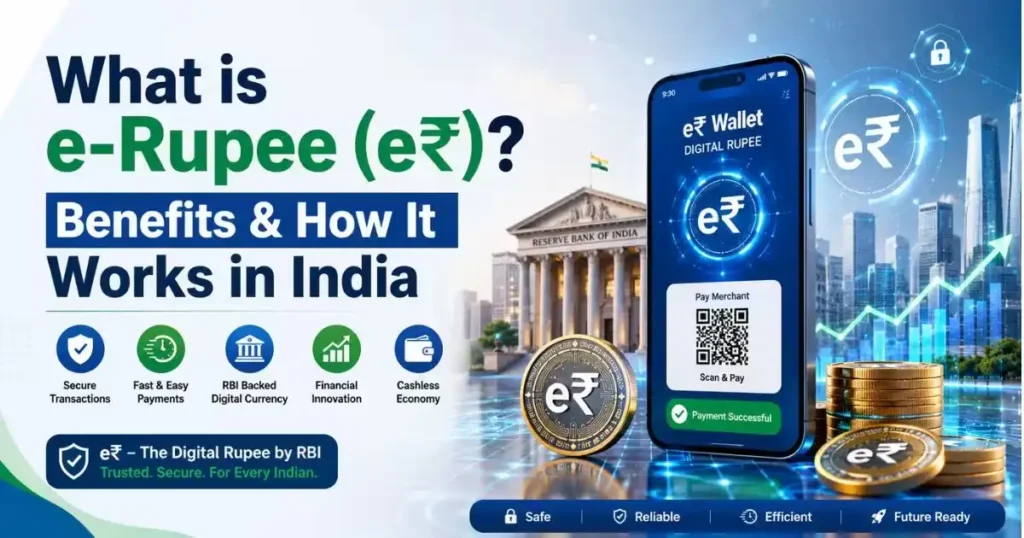
India is moving quickly toward a digital economy, and the e-Rupee (e₹) is one of the biggest steps in this journey. Issued by the Reserve Bank of India (RBI), the e₹ is a digital form of money that can be used for everyday payments. In this guide, you’ll learn what the e-Rupee is, how it works, its benefits, and how it is different from UPI and cryptocurrencies.
Digital payments are now a part of everyday life in India. To support the future of digital finance, the Reserve Bank of India (RBI) introduced the e-Rupee (e₹), also known as the Digital Rupee.
The e-Rupee is India’s Central Bank Digital Currency (CBDC), issued and backed by the RBI. Unlike cryptocurrencies, it is official money and has the same value as physical cash. It aims to make payments faster, safer, and more efficient for individuals, businesses, and the overall economy.
What is e-Rupee (e₹)?
The e-Rupee (e₹) is a digital form of the Indian Rupee issued by the Reserve Bank of India. It can be used for payments just like cash but exists in digital form.
Think of it as a digital version of the currency notes in your wallet. One e₹ is equal to one physical Rupee.
Key points:
- Issued by the RBI
- Legal tender in India
- Same value as physical cash
- Stored in a digital wallet
- Can be used for payments and transfers
Types of e-Rupee
The RBI has introduced two main forms of the Digital Rupee:
1. Retail e-Rupee (e₹-R)
Used by individuals and businesses for everyday transactions like shopping, payments, and transfers.
2. Wholesale e-Rupee (e₹-W)
Used by banks and financial institutions for large-value transactions and interbank settlements.
What is CBDC?
CBDC stands for Central Bank Digital Currency.
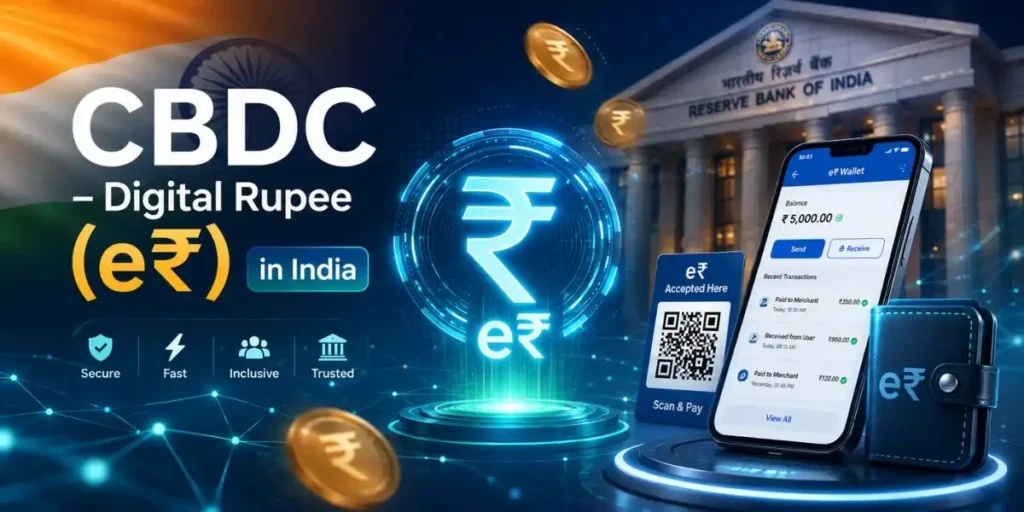
A CBDC is a digital currency issued and regulated by a country’s central bank. In India, the RBI is responsible for issuing the e-Rupee.
Unlike private cryptocurrencies, CBDCs are fully regulated and backed by the government.
For detailed information about India’s CBDC framework, visit the Reserve Bank of India (RBI).
How Does e-Rupee Work?
The e-Rupee works through a digital wallet provided by participating banks.
Here’s a simple process:
Step 1: Get a Digital Wallet
Users can download a supported bank’s CBDC wallet app.
Step 2: Add e₹ to the Wallet
Money can be converted into e-Rupee and stored in the wallet.
Step 3: Make Payments
Users can pay merchants or transfer money to others using QR codes or wallet transfers.
Step 4: Receive e₹
The receiver gets the digital currency directly in their wallet.The entire process is quick and secure.
Key Features of e-Rupee
| Feature | Description |
|---|---|
| RBI Backed | Issued by the Reserve Bank of India, making it highly reliable |
| Digital Form of Cash | Works like physical cash but in electronic form |
| Legal Tender | Officially recognized as money in India |
| Fast Transactions | Payments can be completed almost instantly |
| Secure Transactions | Advanced security measures protect users and transactions |
| Reduced Cash Handling | Reduces the need to print, transport, and manage physical currency |
Benefits of e-Rupee
The e-Rupee (e₹), issued by the Reserve Bank of India (RBI), offers several benefits that make digital payments easier, safer, and more efficient in India’s growing digital economy.
1. Easy Digital Payments
Users can make quick payments without carrying cash.
2. Safer Than Physical Cash
There is less risk of theft or loss compared to paper currency.
3. Lower Transaction Costs
Digital transactions can reduce costs for banks and businesses.
4. Financial Inclusion
More people can access digital payment systems.
5. Faster Settlement
Transactions settle quickly without delays.
6. Supports Digital India
The e-Rupee helps strengthen India’s digital economy.
The e-Rupee supports the government’s vision of a digitally empowered economy through the Digital India initiative.
e-Rupee vs UPI
Many people think e-Rupee and UPI are the same, but they are different.
| Feature | e-Rupee | UPI |
|---|---|---|
| Issued By | RBI | Payment System |
| Type | Digital Currency | Payment Platform |
| Linked to Bank Account | Not Always | Yes |
| Legal Tender | Yes | No |
| Works Like Cash | Yes | No |
| Government Backed Currency | Yes | No |
UPI is operated by the National Payments Corporation of India (NPCI) and enables instant bank-to-bank payments.The e-Rupee itself is digital money.
e-Rupee vs Cryptocurrency
The e-Rupee is also different from cryptocurrencies such as Bitcoin.
| Feature | e-Rupee | Cryptocurrency |
| Issuer | RBI | Private Networks |
| Regulation | Fully Regulated | Often Unregulated |
| Value Stability | Stable | Highly Volatile |
| Legal Status | Legal Tender | Not Legal Tender |
| Government Backing | Yes | No |
The e-Rupee is designed to provide the benefits of digital payments without the price volatility of cryptocurrencies.
Where Can e-Rupee Be Used?
The Digital Rupee can be used for:
- Shopping at stores
- Online payments
- Peer-to-peer transfers
- Merchant payments
- Everyday purchases
As adoption grows, more businesses and service providers are expected to accept e-Rupee payments.
Is e-Rupee Safe?
Yes. The e-Rupee is issued and regulated by the RBI.
Benefits of its security framework include:
- Strong encryption
- Secure wallet systems
- RBI oversight
- Reduced risk of counterfeit currency
Users should still follow basic digital safety practices such as protecting passwords and wallet access.
Challenges of e-Rupee
- Low public awareness
- Digital literacy gaps
- Merchant adoption is still growing
- Internet/smartphone dependency
Future of e-Rupee in India
The future of the e-Rupee looks promising.
As digital payments continue to grow, the Digital Rupee may become a common payment option across India. It can help improve financial inclusion, reduce cash management costs, and support innovation in the banking system.
The RBI is expected to continue expanding its CBDC ecosystem and adding new features over time.
Conclusion
The e-Rupee (e₹) is India’s official digital currency issued by the Reserve Bank of India. It combines the convenience of digital payments with the trust and security of government-backed money. Unlike UPI, which is a payment system, the e-Rupee is actual digital currency. It also differs from cryptocurrencies because it is regulated, stable, and recognized as legal tender.
As India moves toward a more digital economy, the e-Rupee could play a major role in the future of payments and financial services.
Read more:
- Best Credit Cards for Beginners in India 2026
- How to Receive Money in PayPal in India (2026 Guide)
- How to Withdraw PF Through ATM and UPI
- Current Account vs Savings Account: Which is Better?
FAQs
Q1. What is e-Rupee (e₹)?
The e-Rupee is India’s official digital currency issued by the Reserve Bank of India (RBI).
Q2. Is e-Rupee the same as UPI?
No. UPI is a payment system, while e-Rupee is digital currency issued by the RBI.
Q3. Is e-Rupee legal in India?
Yes. The e-Rupee is legal tender and is backed by the RBI.
Q4. Can I withdraw an e-rupee?
No, e-Rupee cannot be withdrawn as cash; it can only be stored in a digital wallet and used for payments or transfers.
Q5. Is the e-rupee safe to use?
Yes. It is issued and regulated by the RBI and includes strong security features.
Q6. Does e-Rupee replace cash?
No. It currently works alongside physical cash and existing payment methods.
Q7. Can it work without bank account?
Depending on the wallet design and RBI guidelines, some use cases may not require a traditional bank account.
Q8. Is e-Rupee a cryptocurrency?
No. The e-Rupee is a government-backed digital currency, while cryptocurrencies are decentralized digital assets.