
India has revised the FRB 2031 (Floating Rate Bond) interest rate to 6.64% for the next six months, impacting government bond investors across the country. Here’s what this update means for your returns, risk, and long-term investment strategy in 2026.
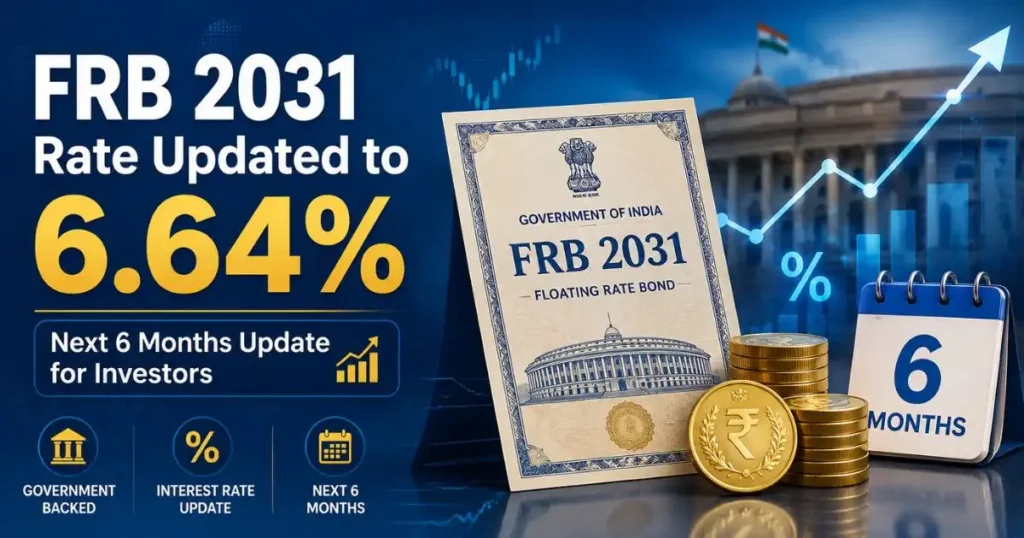
Floating Rate Bonds (FRBs) are government-backed debt instruments whose interest rates change periodically based on benchmark rates. The latest revision of FRB 2031 to 6.64% signals a shift in India’s interest rate environment and can influence returns for retail and institutional investors alike. According to official updates from the Reserve Bank of India, such changes in floating rate securities reflect broader market interest rate movements and monetary policy conditions.
For investors seeking predictable income with minimal risk, this update is significant because it directly affects coupon payouts over the next six months. More details on the announcement were also reported by CNBC TV18, along with coverage from Economic Times Markets, which regularly tracks government bond and interest rate movements in India.
What is FRB 2031?
The FRB 2031 is a Government of India-issued floating rate bond with a maturity year of 2031.
These bonds are issued under the supervision of the Reserve Bank of India and are backed by the Government of India, making them one of the safest fixed-income instruments available in the country.
Key Features of FRB 2031:
- Issued by the Government of India
- Floating interest rate (changes periodically)
- Maturity year: 2031
- Semi-annual interest payouts
- Benchmark-linked returns
What Does 6.64% Interest Rate Mean?
The updated 6.64% interest rate means that investors holding FRB 2031 will earn approximately 6.64% annualized return (paid semi-annually) for the next six months.
However, this rate is not fixed permanently. It adjusts based on benchmark rates such as:
- Treasury bill yields
- RBI policy rate trends
- Market interest rate conditions
This ensures that investors receive returns aligned with current economic conditions.
How FRB 2031 Interest is Calculated
Floating Rate Bonds typically follow a formula linked to a benchmark rate plus a fixed spread.
Coupon Rate=Benchmark Rate+Spread
For example:
- If benchmark rate changes → FRB rate changes
- If inflation or RBI policy shifts → bond yield adjusts accordingly
This structure protects investors from long-term interest rate risk.
Why Has the FRB 2031 Rate Been Updated?
The revision to 6.64% is generally influenced by macroeconomic conditions such as:
1. RBI Policy Changes
The Reserve Bank of India adjusts monetary policy based on inflation and growth.
2. Inflation Trends
Higher inflation usually leads to higher interest rates on floating instruments.
3. Government Borrowing Costs
The government adjusts bond yields to maintain demand in debt markets.
Impact on Investors
The FRB 2031 rate update has several implications:
1. Stable but Flexible Returns
Investors continue to receive safe returns, but the yield may fluctuate over time.
2. Better Protection Against Inflation
Since rates adjust periodically, FRBs help preserve purchasing power better than fixed-rate bonds during rising inflation.
3. Attractive for Conservative Investors
FRBs remain ideal for:
- Risk-averse investors
- Retirees
- Long-term wealth preservation
FRB vs Fixed Rate Bonds
| Feature | FRB (Floating Rate Bond) | Fixed Rate Bond |
|---|---|---|
| Interest Rate | Variable | Fixed |
| Risk Level | Low | Low |
| Inflation Protection | High | Low |
| Return Stability | Medium | High |
| Suitability | Rising rate environment | Stable rate environment |
Who Should Invest in FRB 2031?
FRB 2031 is suitable for:
Conservative Investors
Those who want safety with moderate returns.
Long-Term Investors
People planning for retirement or future financial goals.
Fixed Income Portfolio Builders
Investors who want to diversify beyond fixed deposits and debt funds.
Advantages of FRB 2031
1. Government-Backed Safety
Since it is issued by the Government of India, default risk is extremely low.
2. Inflation-Linked Returns
Returns adjust with market conditions.
3. Regular Income
Interest is paid semi-annually, offering predictable cash flow.
4. Liquidity in Secondary Market
Investors can trade FRBs in the secondary market if needed.
Risks of FRB 2031
Even though FRBs are safe, they are not risk-free:
1. Interest Rate Uncertainty
Returns may decrease if benchmark rates fall.
2. Market Price Fluctuation
Bond prices can fluctuate in the secondary market.
3. Lower Returns in Falling Rate Cycle
If RBI reduces rates, FRB returns also decline.
How Investors Can Buy FRB 2031
Investors can purchase FRB 2031 through:
- Banks
- Stock exchanges (via Demat account)
- Primary auctions (government issuances)
A Demat account is required for most secondary market transactions.
Future Outlook of FRB 2031
With changing global and domestic economic conditions, floating rate instruments like FRB 2031 are expected to remain relevant.
If interest rates stay volatile, FRBs can continue to offer a balanced mix of safety and adaptive returns for investors in India.
Conclusion
The update of FRB 2031 to 6.64% for the next six months reflects ongoing changes in India’s interest rate environment. Backed by the Government of India and regulated by the Reserve Bank of India, FRBs remain one of the safest investment options for conservative investors.
While they may not offer extremely high returns, their stability, inflation protection, and government backing make them a strong choice for long-term wealth preservation.
Read More:
- How to Invest in Bonds in India: Beginner Guide (2026)
- Stocks vs Bonds: Which Investment is Better for You in 2026?
- Top Low-Risk Investment Options for 1 Year in India 2026
- Best Low-Risk Mutual Funds in India 2026
FAQs
Q1. What is FRB 2031?
FRB 2031 is a Government of India floating rate bond that matures in 2031 and offers variable interest rates.
Q2. What is the current FRB 2031 rate?
The current updated rate is 6.64% for the next six months.
Q3. Is FRB 2031 safe?
Yes, it is backed by the Government of India, making it a very low-risk investment.
Q4. How often does the FRB interest rate change?
It is typically revised every six months based on benchmark rates.
Q5. Who should invest in FRBs?
Conservative investors, retirees, and those seeking stable fixed-income returns should consider FRBs.